[Vienna Congress 1815:
The Jewish rights after the partly emancipation of the
Jews under Napoleon are not renewed]
VIENNA, CONGRESS OF,
international congress held in Vienna, September 1814 to
June 1815, to reestablish peace and order in Europe after
the Napoleonic Wars. the congress met in the Apollosaal
[[Apollo hall]] built by the English-born Jew, Sigmund
Wolffsohn, and the delegates were often entertained during
the course of the proceedings in the (col. 131)
*salons of Jewish hostesses, such as Fanny von *Arnstein
and Cecily *Eskeles.
The Jewish question, raised explicitly for the first time
at an international conference, arose in connection with
the constitution of a new federation of German states. The
Jews of Frankfort and of the Hanseatic towns of *Hamburg,
*Luebeck, and *Bremen had previously attained equal civil
rights under French rule. The Hanseatic cities were
annexed to France in 1810, and Jewish emancipation in
France was effective ipso facto there. The Frankfort
community paid the French staff of the duke a vast sum of
money in 1811 in return for being granted equality. They
now sent delegates to the Congress to seek confirmation of
their rights, as well as emancipation for the Jews of the
other German states.
The delegates for Frankfort were Gabriel Oppenheimer and
Jacob Baruch (the father of Ludwig *Boerne), while the
Hanseatic towns were represented among others, by the
non-Jew Carl August *Buchholz. They succeeded in gaining
the support of such leading personalities as Metternich
(Austria), Hardenberg, and Humboldt (Prussia). In October
1814 a committee of five German states met to prepare
proposals for the constitution of the new federation.
Bavaria and Wuerttemberg, fearing the curtailment of their
independence, opposed Austria, Prussia, and Hanover,
specially on the question of Jewish rights.
At the general session of the Congress in May 1815, the
opposition to Jewish civil equality grew, despite
favorable proposals by Austria and Prussia. On June 10,
paragraph 16 of the constitution of the German Federation
was resolved:
The Assembly of the
Federation will deliberate how to achieve the civic
improvement of the members of the Jewish religion in
Germany in as generally agreed a form as possible, in
particular as to how to grant and insure for them the
possibility of enjoying civic rights in return for the
acceptance of all civic duties in the states of the
Federation; until then, the members of this religion
will have safeguarded for them the rights which have
already been granted to them by the single states of the
Federation.
This formulation postponed Jewish equality to the far
distant future, while by changing one word in the final
draft to "by", instead of "in the states", a formulation
arrived at only at the meeting on June 8, a loophole had
been left by which the states could disown rights granted
by any but the lawful government, namely, those bestowed
by the French or their temporary rulers. The Congress,
therefore, did nothing to better the status of the Jews
but, in effect, only worsened their position in many
places.
The Jewish question arose again at the Conference of
Aix-la-Chapelle (1818), when the powers met to determine
the withdrawal of troops from France and consider France's
indemnity to the allies. Various Jewish communities turned
to the conference for relief, and Lewis *Way, an English
clergyman, presented a petition for emancipation to
Alexander I of Russia. Despite a sympathetic reception,
however, there were no practical results.
Bibliography:
M. J. Kohler, in: AJHSP, 26 (1918), 33-125
-- L. Wolf: Notes on the Diplomatic History of the Jewish
Question (1919), 12-15
-- S.W. Baron: Die Judenfrage auf dem Wiener Kongress
(1920)
-- M. Grunwald: Vienna (1936), 190-204.
[S.ETT.]> (col. 132)
[since 1815: Emancipation
of the Jews in Vienna step by step - Haskalah and flow
of Jews from Galicia - new generation of Jewish
intellectuals]
At the time of the Congress of Vienna in 1815 (see
*Vienna, Congress of) the salons of Jewish hostesses
served as entertainment and meeting places for the rulers
of Europe. In 1821 nine Jews of Vienna were raised to the
nobility.
From the close of the 18th century, and especially during
the first decades of the 19th, Vienna became a center of
the *Haskalah movement. The influence and scope of the
community's activities increased particularly after the
annexation of *Galicia by Austria.
Despite restrictions, the number of Jews in the city
rapidly increased. Several Hebrew authors, including the
poet and traveler Samuel Aaron *Romanelli, the philologist
Judah Leib *Ben-Zeev, the poet Solomon Levisohn, Meir
*Letteris, etc., wrote their works in Vienna. Some of them
earned their livelihood as proofreaders in the city's
Hebrew press. The character of Haskalah and the literature
of the Jews of Vienna was gradually Germanized. There
emerged a generation of intellectuals, such as Ludwig
August *Frankl, Moritz *Hartmann, Leopold *Kompert, and
Ignaz *Kuranda, that did not know Hebrew. The first Jewish
journalists, such as Isidor Heller, Moritz Kuh, and
Zigmund Kulischer, inaugurated an era of Jewish influence
on the Viennese press.
[Inner Jewish struggle
about religious reforms in Vienna - Isaac Noah
Mannheimer]
At a later period the call for religious reform was heard
in Vienna. Various
maskilim,
including Peter Peretz *Ber and Naphtali Hertz *Homberg,
tried to convince the government to impose Haskalah
recommendations and religious reform on the Jews. This
aroused strong controversy among the Vienna community. The
appointment of Isaac Noah *Mannheimer as director of the
religious school in 1825 was a compromise between the
supporters of reform and its opponents.
In 1826 a magnificent synagogue, in which the Hebrew
language and the traditional text of the prayers were
retained, was inaugurated. It was the first legal
synagogue to be opened since 1671. Mannheimer and the
hazzan [[cantor]]
Solomon *Sulzer tried to improve the decorum of the
services in the new synagogue, which became a model for
all the countries of the Austrian empire.
[1850-1920: Significant
Jewish immigration to Vienna from the eastern regions of
Austria-Hungary - figures]
During the second half of the 19th century and the first
decades of the 20th, the Jewish population of Vienna
increased as a result of immigration there by Jews from
other regions of the empire, particularly Hungary,
Galicia, and Bukovina. There were 3,739 Jews living in
Vienna in 1846, 9,731 in 1850, and about 15,000 in 1854.
After 1914 about 50,000 refugees from Galicia and Bukovina
established themselves there, so that by 1923 there were
201,513 Jews living in Vienna, which had become the third
largest Jewish community in Europe. In 1936 there were
176,034 Jews in Vienna (8% of the total population).
Jews in Vienna
|
Year
|
number of Jews
|
1846
|
3,739xxxxxxxxxxxxxxxxxx
|
1850
|
9,731xxxxxxxxxxxxxxxxxx |
1854
|
15,000xxxxxxxxxxxxxxxxxx |
1923
|
201,513xxxxxxxxxxxxxxxxxx |
1936
|
176,034xxxxxxxxxxxxxxxxxx |
Table by Michael
Palomino; from: Vienna; In: Encyclopaedia
Judaica, vol. 16, col. 124
|
The occupations of the Jews in Vienna became more
variegated. Many of them entered the liberal professions:
out of a total of 2,163 advocates, 1,345 were Jews, and
2,440 of the 3,268 physicians were Jews. Prominent as a
financier and industrialist was Moritz Pollak (1877-1904)
who was a member of the Vienna city council and president
of the Jewish community.
[Jewish outstanding
personalities and Jewish institutions before 1933]
Before the Holocaust there were about 59 synagogues of
various religious trends in Vienna. There was also a
Jewish educational network. The rabbinical seminary,
founded in (col. 124)
1893, was a European center for research into Jewish
literature and history. The most prominent scholars were
M. *Guedemann, A. *Jellinek, Adolph *Schwarz, Adolf
*Buechler, David *Mueller, Victor *Aptowitzer, Z. H.
*Cahjes, and Samuel *Krauss.
There was also a "Hebrew Pedagogium" for the training of
Hebrew teachers. Many charitable and relief institutions
existed in the town, including the Rothschild Hospital and
three orphanages. Vienna also became a Jewish sports
center; the football team Ha-Koah and the *Maccabi
organization of Vienna were well known. A Jewish daily
newspaper in German,
Wiener
Morgenzeitung [[Vienna Morning Post]], was
published from 1919 to 1927.
Viennese scientists, musicians, and writers of Jewish
origin (Jews and apostates) achieved world fame, including
the authors Arthur *Schnitzler, Franz *Werfel, Richard
*Beer-Hofmann, Jakob *Wassermann, Stefan *Zweig, and Felix
*Salten, and the musicians Gustav *Mahler, and Arnold
*Schoenberg. Many Jews were actors and producers.
Scientists, researchers, and thinkers included Sigmund
*Freud, Heinrich Neumann, Joseph *Unger, and Joseph
*Popper-Linkeus. Among Jews active in general politics
were Adolf *Fischhof, Victor *Adler, Max *Adler, and Otto
*Bauer. The leading newspaper,
Neue Freie Presse, to which Theodor
*Herzl contributed, was owned in part by Jews.
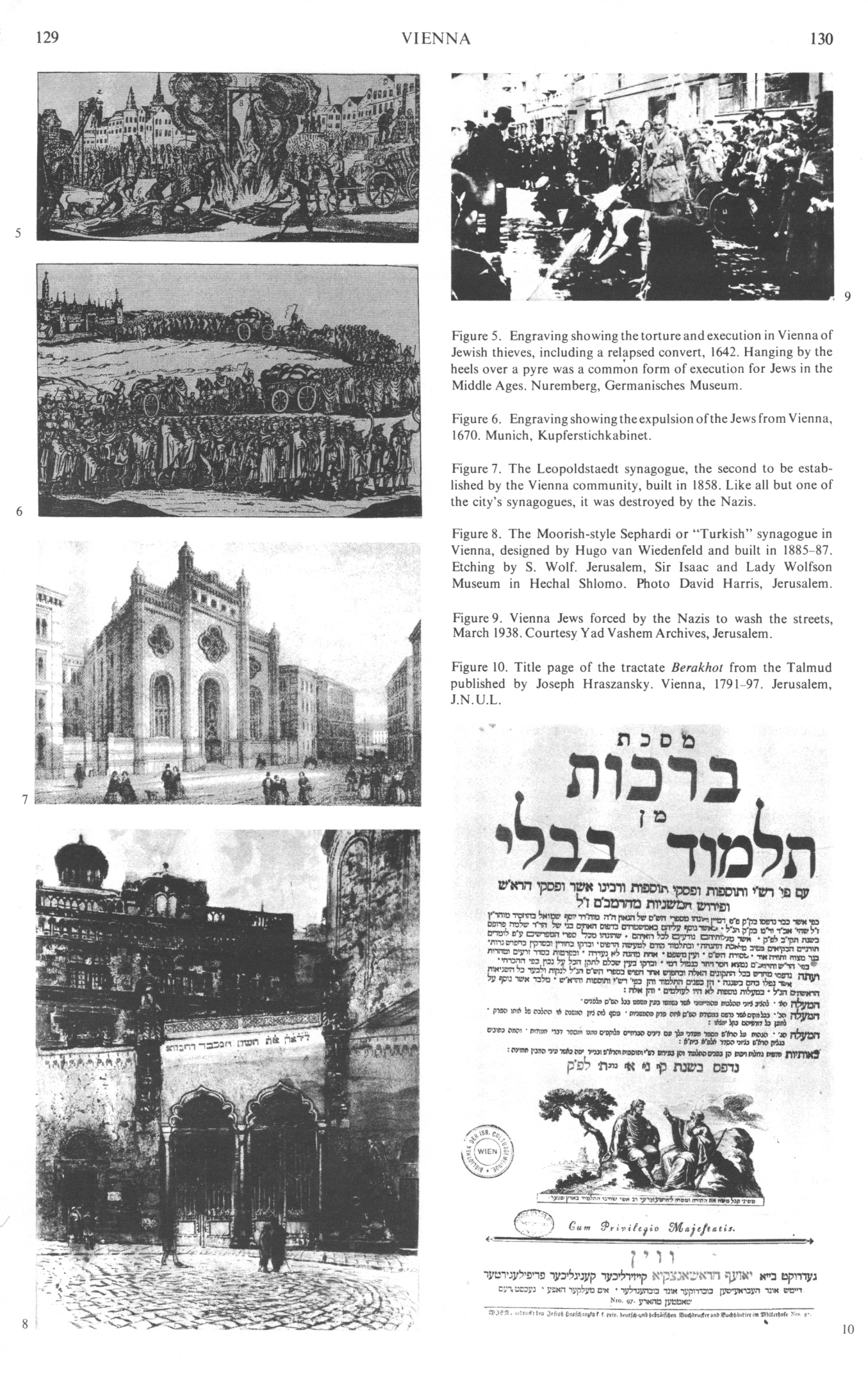
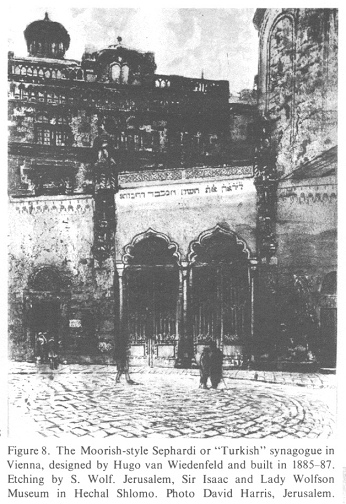 |
Encyclopaedia Judaica: Vienna, vol.16,
col.129, Sephardi synagogue of 1887: The
Moorish-style Sephardi or "Turkish" synagogue in
Vienna, designed by Hugo van Wiedenfeld and
built in 1885-87. Etching by S. Wolf. Jerusalem,
Sir Isaac and Lady Wolfson Museum in Hechal
Shlomo. Photo David Harris, Jerusalem. |
[Nationalism and Jewish
nationalism in Vienna - Herzl Zionism against all Arabs]
Though in the social life and the administration of the
community, there was mostly strong opposition to Jewish
national action, Vienna was also a center of the national
awakening. Peretz *Smolenskin published *Ha-Shahar between
1868 and 1885 in Vienna, while Nathan *Birnbaum founded
the first Jewish nationalist student association,
*Kadimah, there in 1882, and preached "pre-Herzl Zionism"
from 1884. It was due to Herzl that Vienna was at first
the center of Zionist activities [[provoked by the
Dreyfus
case in France. Herzl stated in his book "The Jewish
State" that an Israel could be found and all Arabs could
be driven away like the natives in the "USA", and this
would be a "modern solution" of the "Jewish question"]].
He published the Zionist movement's organ,
Die *Welt, and
established the headquarters of the Zionist Executive
there. The Zionist movement in Vienna gained in strength
after World War I. In 1919 the Zionist Robert *Stricker
was elected to the Austrian parliament. The Zionists did
not obtain a majority in the community until the elections
of 1932. Desider *Friedmann was the last president of the
community of Vienna before its destruction in the
Holocaust.
[YO.BA.]> (col. 127)
[[Supplement: The Arab
reaction on Herzl
At the same time the Arabs at once founded newspapers
against Herzl Zionism. Herzl never has been in Palestine,
has never spoken with any Arab, and 10,000s of
impoverished Jews of Eastern Europe and since 1933 German
and Austrian emigrating Jews went into the Herzl trap: the
eternal war against the Arabs of whom Zionist agitators
never had spoken. Palestinians got no voice in the UNO
until 1974, and the Herzl book is not forbidden until now
(2007). Human rights would be better. Details about Herzl
Zionism see under
Zionism...]]
[[Supplement: National
frustrations and anti-Semitism in German Austria
1871-1918 - the Austrian Hitler
There are more subjects to consider about the time between
1871 and 1918: Since 1848 (since the establishment of the
liberty of the press) the Jewish press and the national
anti-Semitic press in Austria were fighting against each
other. Since 1871 since the German victory against France
the German Austrians had the feeling that they would like
to belong to Germany because they would have liked to be
"present" in the Second Empire of Bismarck. But the
Emperor of Vienna never wanted a union with Berlin because
otherwise he had to subordinate to the German Emperor of
Berlin. Add to this after the worldwide collapse of the
stock markets in 1873 the Emperor of Vienna helped the
Jewish banks in Austria but did not help the normal
Austrian citizens, and Austria did not have an insurance
system like Bismarck's Germany had. So the anti-Semitism
in Austria was raising much since 1873 against the rich
Jews and the Jews at court in Austria without considering
that there were also many poor Jews suffering by the
economic crisis.
During World War I the Jews were serving in the army, and
Austria and Germany tried to germanize all Europe. In 1918
Austria-Hungary was split, and the Jewish politicians in
the new mini Austria were always heavily attacked by
nationals with anti-Semitism which wanted to have the
Empire back and wanted to be a member of Germany at last,
but now the French dominance in Europe prohibited the
union. Add to this also in Germany was a big frustration
now because of the loss of all colonies and of German
territories. This combination of national frustrations in
Germany and Austria at the same time was in the head of an
Austrian person which name was Adolf Hitler. He was seen
as a leader for re-establishment of "German honor" in the
world, and the German industrial leaders and the
industrial leaders of the "USA" ... supported this
criminal foreigner in Germany ... and the German police
did not act against this criminal foreigner and did not
kick him out to Austria ...]]


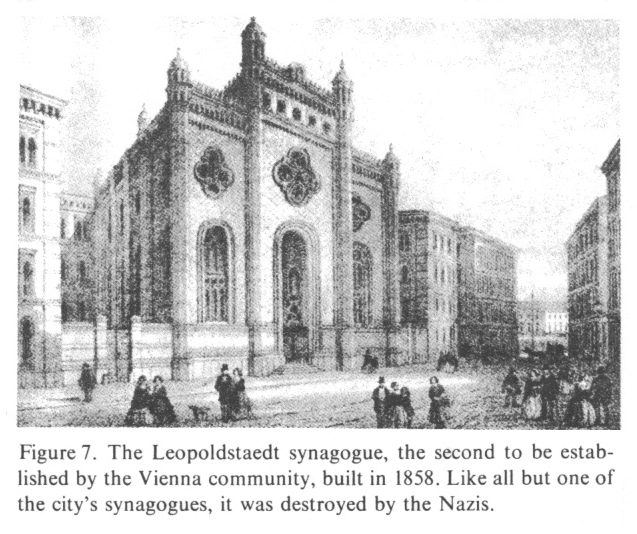
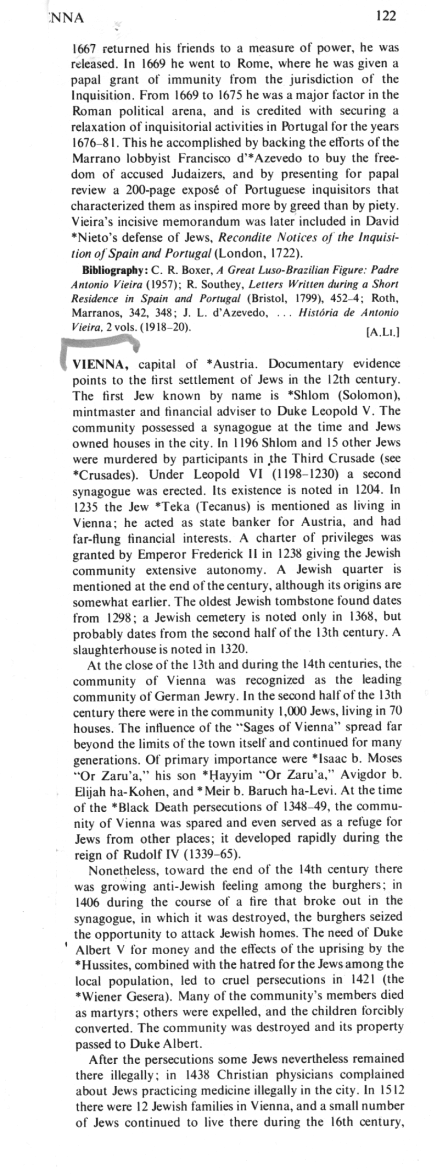
 Encyclopaedia
Judaica
1971: Vienna, vol. 16, col. 122
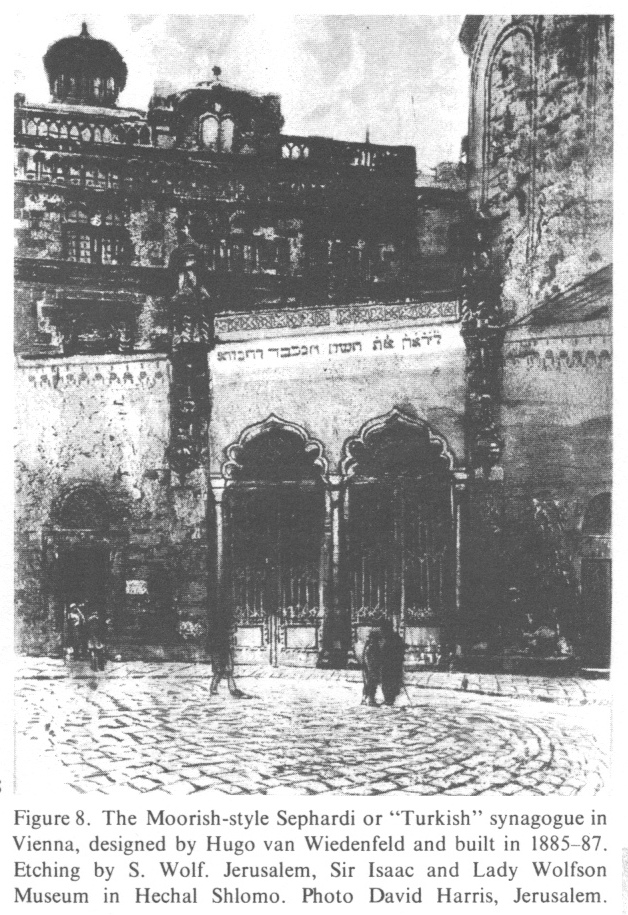
Encyclopaedia
Judaica
1971: Vienna, vol. 16, col. 122