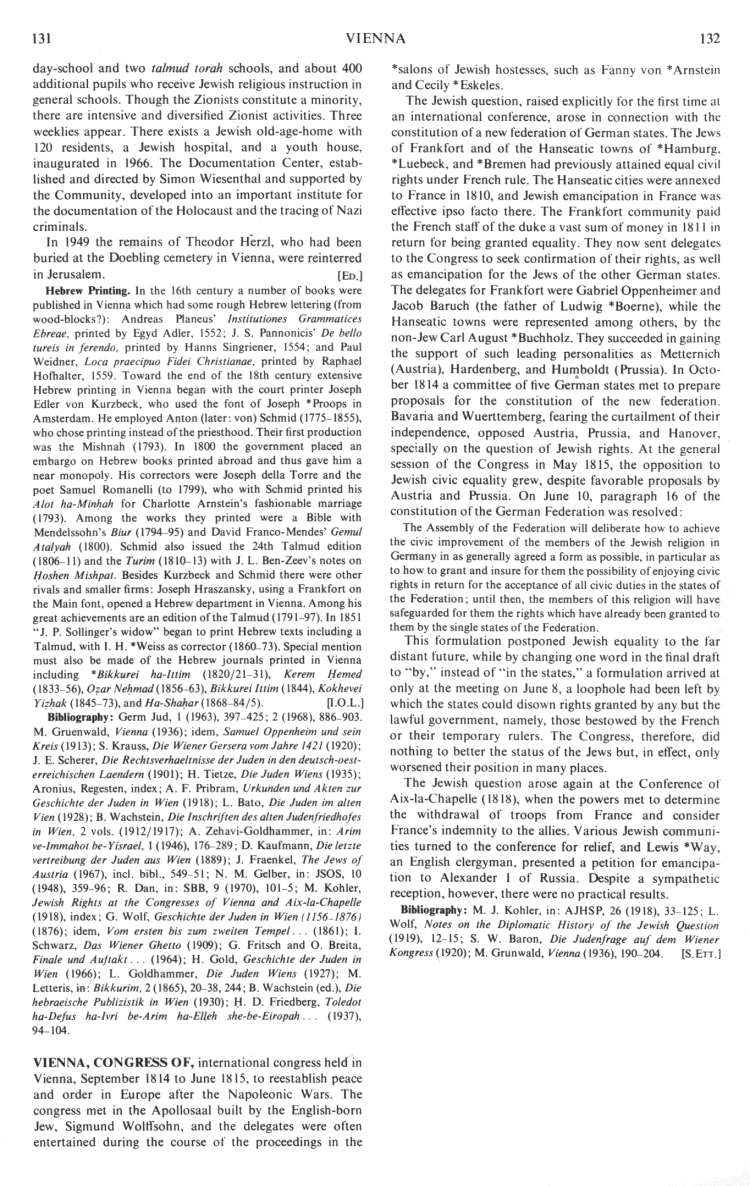
[Nazi rule -
concentration camps - cleaning pavements - 42 synagogues
destroyed - lethal victims - arrests - plundered shops
and flats - confiscations]
The Holocaust Period. The
experience
and practice in dealing with the Jews, gained in Germany
since 1933, were utilized by the Nazis when they occupied
Vienna in March 1938 with great harshness and brutality.
In less than one year they introduced all the
discriminatory laws, backed by ruthless terror and by mass
arrests (usually of economic leaders and intellectuals,
who were detained in special camps or sent to Dachau).
These measures were accompanied by unspeakable atrocities.
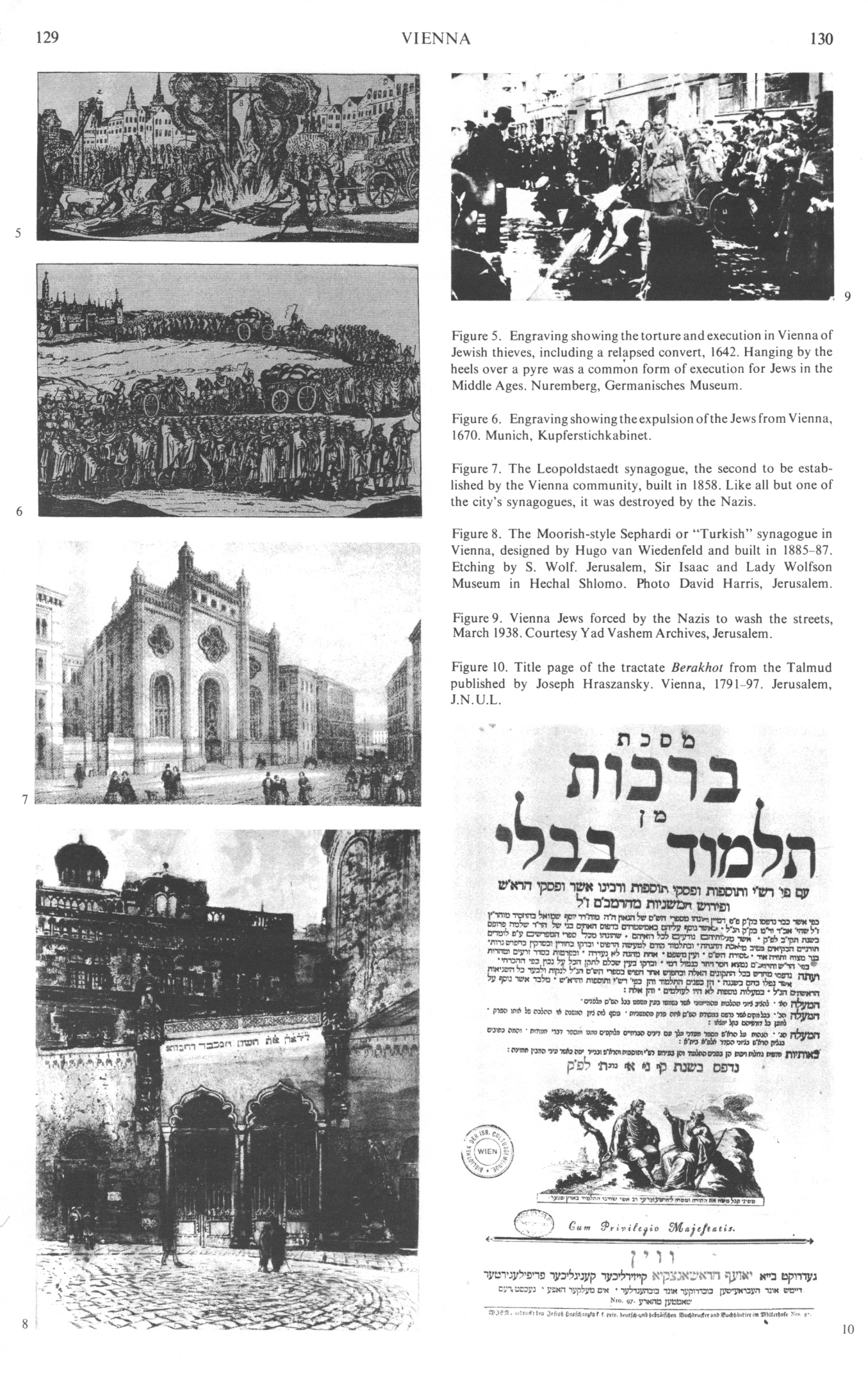
Vienna's chief rabbi, Dr. Israel Taglicht, who was more
than 75 years old, was among those who were forced to
clean with their bare hands the pavements of main streets.
The president of the community, Desider Friedmann, the
vice-president, Robert *Stricker, and the director, Josef
Loewenherz, as well as the president of the Zionist
organization, Oskar Gruenbaum, were immediately arrested.
The historian of the Zionist movement, Adolf Boehm became
insane, dying in prison shortly afterward. During
Kristallnacht (November 9-10, 1938), 42 synagogues were
destroyed, hundreds of people perished, and thousands were
arrested; shops and flats were plundered by the S.A. and
the Hitler Youth, subsequently being confiscated.
[[This is the outburst of all the frustration which has
accumulated in German Austria from 1871 to 1938]].
Nonetheless, the organization of immigration and the
transfer of property necessitated the release of some
Jewish leaders who had to form the
Aeltestenrat
[["Council of Jewish Elders"]]. Aryanization was practiced
by the forced sale and liquidation of thousands of (col.
127)
enterprises; apartments had to be evacuated.
[Organized forced
emigration: figures - deportations]
Moreover, for the first time, forced emigration (legal and
"illegal") was systematically organized by Eichmann's
Zentralstelle fuer juedische Auswanderung [[Central office
for Jewish emigration]]. Consequently, of Vienna's 166,000
Jews (approximately 10% of the city's population) about
100,000 emigrated before the war; about 18,000 or them
were later caught in other European countries; an
additional 18,500 succeeded in getting out before the
general ban on emigration in the fall of 1941.
With the outbreak of war deportation of Austrian Jews
increased, whereas previously mainly those of Polish and
Czech nationality had been expelled. The first transports
were sent to the notorious Nisko, in the Lublin district
(October 1939). The last mass transport left in September
1942; it included many prominent people and Jewish
dignitaries, who were sent to Theresienstadt, from where
later they were mostly deported to Auschwitz [[and into
the tunnel systems or trench digging]]. In November 1942
the Jewish community of Vienna was officially dissolved.
The "Council of Jewish Elders", with Loewenherz at its
head, continued to exist. About 800 Vienese Jews succeeded
in remaining underground.
For further details and bibliography, see *
Austria,
Holocaust.
[[According to the racist Nazi law also non-Aryans counted
as Jews (half Jews, quarter Jews, and 3/4 Jews), also see
in the book of Yehuda Bauer: American Joint Distribution
Committee:
--
185,246
counted
Jews in Austria
--
annexation
and
the riots and Palestine office
--
at
least
150,000 non Aryans (half Jews, quarter Jews, and 3/4
Jews)
--
"US"
organizations
can only watch ].


 Encyclopaedia
Judaica
1971: Vienna, vol. 16, col. 122
Encyclopaedia
Judaica
1971: Vienna, vol. 16, col. 122