|
|
|


IT'S ALL A LIE
- Uwe Topper: The Big Action 09: When was our [FAKE] Bible
created?
The criminal gay drug Vatican is also a faking company
The criminal gay drug Vatican is also a faking company
9.1. Basics about the poetry of FAKE OT and FAKE NT
9.2. The New [Fantasy] Testament [as an instruction manual for the priests - and the subtle manipulation of history]
9.3. The Old [Fantasy] Testament [FAKE Torah of Judaism]
9.4. The New [Fantasy] Testament
9.5. First results: mystery plays [playing "Resurrection" - and then specifically with the Fantasy Jesus]
9.6. Approach [from collections of sayings to the Fantasy "canon"]
9.7. [Fantasy calendar]: different year countings
from: The Big Action.
Europe's invented history. The Systematic Falsification
of Our Past from Antiquity to the Enlightenment --
orig. German: Die Grosse Aktion. Europas erfundene Geschichte. Die planmässige Fälschung unserer Vergangenheit von der Antike bis zur Aufklärung --
Edition Grabert -- ISBN 3-87847-172-6 -- Tübingen 1998; 2nd edition 2000
Commented edition
presented by Michael Palomino (2025)
orig. German: Die Grosse Aktion. Europas erfundene Geschichte. Die planmässige Fälschung unserer Vergangenheit von der Antike bis zur Aufklärung --
Edition Grabert -- ISBN 3-87847-172-6 -- Tübingen 1998; 2nd edition 2000
Commented edition
presented by Michael Palomino (2025)
| Compartir: |
Facebook |
|
Twitter
X |
|
|
|
Mentioned literature
Bücher mit Bibelanalyse (Aufdeckung der Fälschung, Widersprüche+UNmöglichkeiten)
-- das Vorbild für die FAKE-Bibel war: ein "Alexanderroman"
-- Bibelanalyse: Wilhelm Kammeier: Die Fälschung der Geschichte des Urchristentums; 1982
-- Bibelanalyse: Friedrich Delitzsch 1850-1922 [web03]: Die grosse Täuschung; 1920
-- Bibelanalyse: David Strauss: Das Leben Jesu für das deutsche Volk bearbeitet; 1864 (er erkannte das Zusammensetzen verschiedener Texte und die vielen Fälschungen)
-- Bibelanalyse: Arthur Drews (1865-1935 [web06]): Buch "Das Markus-Evengelium als Zeugnis gegen die Geschichtlichkeit Jesu"; Jena 1921
-- Bibelanalyse: Michael Baigent / Richard Leigh (Autoren): Verschlusssache Jesus die Qumranrollen und die Wahrheit über das frühe Christentum; 1991
-- Bibelanalyse: Hermann Detering: Paulusbriefe ohne Paulus? Dissertation, Frankfurt am Main 1992
-- Kalenderanalyse: August Strobel (1930-2006 [web12]) "Ursprung und Geschichte des frühchristlichen Osterkalenders"; 1977
-- Kalenderanalyse: Kurt Heidrich: Die olympischen Doppeldatierungen, eine Studie zur griechisch-archaischen Geschichte; Ehrenkirchen-Offnadingen 1981
Books with Bible analysis (uncovering the forgery, contradictions + impossibilities)
-- The model for the FAKE Bible was: an "Alexander novel"
-- Bible analysis: Wilhelm Kammeier: The Forgery of the History of Early Christianity; 1982
-- Bible analysis: Friedrich Delitzsch 1850-1922: The Great Deception; 1920
-- Bible analysis: David Strauss: The Life of Jesus for the German People edited; 1864 (he recognized the compilation of different texts and the many forgeries)
-- Bible analysis: Arthur Drews (1865-1935): Book "The Gospel of Mark as Evidence Against the Historicity of Jesus"; Jena 1921
-- Bible analysis: Michael Baigent / Richard Leigh (authors): Classified Information Jesus the Qumran Scrolls and the Truth about Early Christianity; 1991
-- Bible analysis: Hermann Detering: Paul's Letters Without Paul? Dissertation, Frankfurt am Main 1992
-- Calendar analysis: August Strobel (1930-2006 [web12]) 'Origin and History of the Early Christian Easter Calendar'; 1977
-- Calendar analysis: Kurt Heidrich: The Olympic Double Dates, a Study on Greek-Archaic History; Ehrenkirchen-Offnadingen 1981
FAKE-Bücher
-- FAKE-AT, FAKE-NT, FAKE-Briefe
FAKE-Koran
-- Korananalyse: Günter Lüling: Über den Urqur'an; 1974
Artikel
-- Artikel von Miguel Asin Palacios: "Logia et Agrapha D. Jesu"; In: Patrologia orientalis XIII, 3, Paris 1916
Thema Frauen
-- Sigrid Hunke: Am Anfang waren Mann und Frau; Bonn 1958
FAKE Books
-- FAKE-AT, FAKE-NT, FAKE Letters
FAKE Quran
-- Quran Analysis: Günter Lüling: About the Urqur'an; 1974
Articles
-- Article by Miguel Asin Palacios: "Logia et Agrapha D. Jesu"; In: Patrologia Orientalis XIII, 3, Paris 1916
Topic women
-- Sigrid Hunke: In the Beginning Were Man and Woman; Bonn 1958
Content
9.1. Basics about the poetry of FAKE OT and FAKE NT
9.1.A. The Old Fantasy Testament (FAKE-OT): the Torah: written down 1000 years too late - the "Septuagint"
9.1.B. The New Fantasy Testament (FAKE-NT): The Jesus-fantasy theologians believe in the FAKE-chronology + in a "canon"
9.1.C. The analysis: Muslims with FAKE-Quran and Jews with FAKE-Torah provoked the FAKE-Bible
9.1.D. Only comprehensive analyses let the FAKE-1-God religions be exposed.
9.2. The New [Fantasy] Testament [as an instruction manual for the priests - and the subtle manipulation of history]
9.2.A. The INVENTION of the history of the FAKE "Gospels": A set of rules for the priests - regulations in connection with FAKE history - the FAKE chronology in the FAKE NT.
9.3. The Old [Fantasy] Testament [FAKE Torah of Judaism]
9.3.A. Analysts of the FAKE-Bible: Benjamin Kennicott - Johann Gottfried Eichhorn - Uwe Topper: The FAKE-Bible is like German+French literature from the 11th century.
9.3.B. Analysis: The FAKE-Bible is written like the "Alexander romance" in the 11th century.
9.3.C. "Lost books" of the FAKE-OT - false attributions shifted by 500 years - fantastic FAKE stories as a new identity for Judaism.
9.3.D. The COMMON contempt for women in the FAKE-OT, FAKE-NT, and FAKE-Koran - Thesis 11th century - Reason: War tactics of women abduction and men without pads or tampons.
9.3.E. The Old FANTASY-Testament is a total chaos of fragments - contradictions without end.
9.4. The New [Fantasy] Testament
9.4.A. Total impossibilities and linguistic features in the fantasy NT: "Oriental characteristics"
9.4.B. The NT analysis of David Strauss: many forgeries - and examples of further forgeries in world history
9.4.C. NT analysis by Arthur Drews: There are heaps of impossibilities
9.4.D. The refugee thesis from Jerusalem - and the propaganda for reconquest
9.4.E. "Christian" fantasy martyrs: The fantasy "Stephen"
9.4.F. Topper: The emergence of the fantasy NT: The sayings of Jesus
9.4.G. NT analysis by Topper: There are heaps of impossibilities
9.4.H. The church not only invents the fantasy Jesus with the fantasy NT, but also the incitement against "heretics"
9.5. First results: mystery plays [playing "Resurrection" - and then specifically with the Fantasy Jesus]
9.5.A. The "holy book": They all compose one thing: Judaism - Islam - Christianity
[9.5.B.Addendum: Only the "book" counted - all indigenous cultures without books are approved for shooting]
9.5.C. The World War between the Fantasy Book Religions with Fantasy Torah - Fantasy Quran - Fantasy Gospel
[9.5.D. Addendum: WHAT have these fantasy books done? Eradication of primordial knowledge through the "sacred fantasy books"]
9.5.E. The composition of the Fantasy Gospels: The Fantasy Jesus with Death+Resurrection is a copy of the ritual for the deceased among the indigenous people
9.5.F. Funeral ritual with rock graves: Iberian Peninsula - Alsace - Lower Saxony
9.5.G. The funeral ritual at the initiation into "Christianity": The play "Death and Resurrection" - and the fantasy-Jesus is THE SAME
9.5.H. The soul goes "to heaven" - the "Passion plays"
9.5.I. Analysis: Quotes in the fantasy Bible come from drinking sayings or fantasy comedies
9.5.J. Factor illustrations: from 980 for the fantasy gospels
9.5.K. Factor translations
9.6. Approach [from collections of sayings to the Fantasy "canon"]
9.6.A. The first collections of sayings
9.6.B. Numerology in the fantasy gospels - and in the fantasy Quran - Code 114 (112+2)
9.6.C. The reinforcement of the joyful fantasy message through "doubling"
9.6.D. Corrections to the fantasy gospels: The fantasy Last Supper - and the fantasy Jesus becomes an anti-alcoholic9.6.E. Quran against alcohol
9.7. [Fantasy calendar]: different year countings
9.7.A. The Jesus Fantasy Church with Fantasy Years
9.7.B. The "Christian" calendar compared to the Muslim calendar
9.7.C. The fantasy impact time of a fantasy Jesus: 1 to 5 years
9.7.D. Calendar Chaos: Already Judaism prophesied in the FANTASY Talmud an "end of the world" in the year 4250 Jewish calendar (1250 "Christian" calendar)
9.7.E. Calendar Chaos: Fantasy calendar with Olympics
Kapitel 9: Wann entstand unsere [FAKE]-Bibel?
(Wann entstand unsere Bibel?)
9.1. Grundsätzliches zur Dichtung von FAKE-AT und FAKE-NT
9.1.A. Das Alte Fantasie-Testament (FAKE-AT): Die Thora: 1000 Jahre zu spät aufgeschrieben - die "Septuaginta"
9.1.B. Das Neue Fantasie-Testament (FAKE-NT): Die Jesus-Fantasie-Theologen glauben an die FAKE-Chronologie+an einen "Kanon"
9.1.C. Die Analyse: Muslime mit FAKE-Koran und Juden mit FAKE-Thora provozierten die FAKE-Bibel
9.1.D. Erst umfassende Analysen lassen die FAKE-1-Gott-Religionen auffliegen
9.1.A. Das Alte Fantasie-Testament (FAKE-AT): die Thora: ist 1000 Jahre zu spät aufgeschrieben - die "Septuaginta"
-- die 5 Bücher Mose (Pentateuch) wurden NACH dem babylonischen Exil geschrieben, also "rund ein Jahrtausend später" nach dem angeblichen Fantasie-Moses - das ist die Meinung von Jesus-Fantasie-Theologen (S.181)
-- die gesamte Buchsammlung des Alten Fantasie-Testaments [5 Bücher Fantasie-Mose und die Fantasie-Propheten] wurde schliesslich Mitte des 3.Jh. v.0 in Alexandria festgelegt - und soll dort "von 72 jüdischen Gelehrten ins Griechische übertragen" worden sein - und von dieser Aktion soll der Begriff "Septuaginta" (=70) stammen (S.181)
-- "Sie [diese Buchsammlung aus Alexandria] ist „ heute“ nur noch bei den Christen überliefert." (S.181)
Chapter 9: When Did Our [FAKE] Bible Originate?
(When did our Bible come into being?)
9.1. Basics about the poetry of FAKE OT and FAKE NT
9.1.A. The Old Fantasy Testament (FAKE-AT): The Torah: 1000 years too late written - the "Septuagint"
9.1.B. The New Fantasy Testament (FAKE-NT): The Jesus Fantasy Theologians believe in the FAKE chronology + in a "canon"
9.1.C. The analysis: Muslims with a FAKE Koran and Jews with a FAKE Torah provoked the FAKE Bible
9.1.D. Only comprehensive analyses reveal the FAKE-1 God religions
9.1.A. The Old Fantasy Testament (FAKE-AT): the Torah: is written 1000 years too late - the "Septuagint"
-- the 5 books of Moses (Pentateuch) were written AFTER the Babylonian exile, i.e. "about a millennium later" after the alleged fantasy Moses - this is the opinion of Jesus fantasy theologians (p.181)
-- the whole book collection of the Old Fantasy Testament [5 books of Fantasy Moses and the Fantasy Prophets] was finally established in the middle of the 3rd century B.C. in Alexandria - and is said to have been "translated into Greek by 72 Jewish scholars" there - and from this action the term "Septuagint" (=70) is said to come (p.181)
-- "It [this collection of books from Alexandria] has been handed down "today" only among Christians." (p.181)
Topper Quote:
"What does this question want to provoke? For theologians, it has long been decided that the Pentateuch (the five books of Moses) was written "only" after the Babylonian exile, i.e. about a millennium later, when this had been naively attributed to the prophet Moses. And also that several centuries passed before the formation of the entire Old Testament, because this collection of books was "only" established in Alexandria in the middle of the 3rd century BC and was translated into Greek by 72 Jewish scholars, hence the name Septuagint (= 70). It has only been handed down "today" among Christians.
With the New Testament it is even simpler. According to theological view, it was begun soon after the death of Jesus, around 65, and completed as early as the beginning of the 2nd century, around 120 AD. It was not yet completely decided which books belonged to the new canon, but within a century this was also clarified, except for the Revelation of John, which was somewhat inconvenient and was only added later, especially in Byzantium." (p.181)
Topper Zitat:
"Was will diese Fragestellung provozieren? Für Theologen ist es doch längst entschieden, daß der Pentateuch (die fünf Bücher Mose) „erst“ nach dem babylonischen Exil geschrieben wurde, also rund ein Jahrtausend später, als dies naiverweise dem Propheten Mose zugeordnet worden war. Und auch, daß bis zur Ausbildung des gesamten Alten Testamentes noch einmal einige Jahrhunderte vergangen sind, denn diese Buchsammlung war „erst“ Mitte des 3. Jahrhunderts v.Chr. in Alexandria festgelegt und wurde dort von 72 jüdischen Gelehrten ins Griechische übertragen, daher der Name Septuaginta (= 70). Sie ist „ heute“ nur noch bei den Christen überliefert.
Beim Neuen Testament ist es noch einfacher. Es wurde nach theologischer Ansicht bald nach dem Tod Jesu begonnen, etwa um 65, und schon Anfang des 2. Jahrhunderts abgeschlossen, so gegen 120 n.Chr. Zwar war dann noch nicht völlig entschieden, welche Bücher zum neuen Kanon gehören, aber innerhalb eines Jahrhunderts war auch das geklärt, ausgenommen die Offenbarung des Johannes, die etwas unbequem war und erst später eingereiht wurde, besonders in Byzanz." (S.181)
9.1.B. Das Neue Fantasie-Testament (FAKE-NT): Die Jesus-Fantasie-Theologen glauben an die FAKE-Chronologie+an einen "Kanon"
-- die Jesus-Fantasie-Theologen meinen, das Fantasie-NT sei "bald nach dem Tod [des Fantasie]-Jesus" begonnen worden, so um 65, und sei schon "Anfang des 2. Jahrhunderts" abgeschlossen worden, "so gegen 120" (S.181)
-- die Buchsammlung wurde auch "Kanon" genannt und wurde dann bald definitiv festgelegt, ausser die "Offenbarung des Johannes", die "erst später eingereiht wurde, besonders in Byzanz (S.181)
9.1.B. The New Fantasy Testament (FAKE-NT): The Jesus Fantasy Theologians believe in the FAKE chronology + in a "canon"
-- the Jesus-fantasy theologians think that the Fantasy New Testament was started "soon after the death of [the Fantasy] Jesus", about 65, and was already completed "at the beginning of the 2nd century", "about 120" (p.181)
-- the book collection was also called "canon" and was then soon definitively established, except for the "Revelation of John" which "was added later, especially in Byzantium (p.181)
Topper Zitat:
"Und nun stellt ein Nichttheologe nachdrücklich fest, daß diese Datierungen völlig wirklichkeitsfremd erfunden sind. Er möchte noch einmal ein Jahrtausend einschalten, bevor er die Festlegung unserer heutigen Bibel sieht . Dabei meint er natürlich nicht die Veränderungeneinzelner Verse oder Textstellen, die auch in unserem Jahrhundert noch vorkommen. Sondern ganz einfach die Entstehung unserer Bibel. Diese kann vor Beginn des 12. Jahrhunderts nicht abgeschlossen gewesen sein.
Dafür braucht er außer minutiösen Beweisen vor allem ein Motiv. Aus welchem Grund soll die Herstellung einer Heiligen Schrift im 11. Jahrhundert vorgenommen worden sein? Die Antwort ist einfach:"
9.1.C. Die Analyse: Muslime mit FAKE-Koran und Juden mit FAKE-Thora provozierten die FAKE-Bibel
-- Wahrheitswisser, Analytiker und Logiker ("Nichttheologen") stellen fest, dass diese Datierungen "völlig wirklichkeitsfremd" und "erfunden sind" (S.182)
-- die Entstehung der FAKE-Bibel [AT+NT] ist vor dem Jahr 1100 ("vor Beginn des 12.Jh.s") nicht möglich (S.182)
-- die Begründung (S.181): Erst um 1100 wurden Koran und hebräische Thora definitiv fertiggestellt, und dies veranlasste die Jesus-Fantasie-Kirche, ebenfalls ein Buch zusammenzustellen: "Konkurrenzkampf ist das Motiv." (S.182)
Dabei anerkennt der Fantasie-Islam nur Buch-Religionen an und alles andere soll vernichtet werden.
Topper Quote:
"And now a non-theologian emphatically states that these dates are completely out of touch with reality. He wants to turn on another millennium before he sees the definition of our Bible today [so not in the year 150, but 1150]. Of course, he does not mean the changes in individual verses or passages that still occur in our century. But quite simply the creation of our Bible. This cannot have been completed before the beginning of the 12th century.
To do this, he needs not only meticulous evidence, but above all a motive. For what reason is the production of a Holy Scripture supposed to have been carried out in the 11th century? The answer is simple:"
9.1.C. The analysis: Muslims with a FAKE Koran and Jews with a FAKE Torah provoked the FAKE Bible
-- truth-knowers, analysts and logicians ("non-theologians") state that these dates are "completely out of touch with reality" and "invented" (p.182)
-- the origin of the FAKE Bible [AT+NT] is not possible before the year 1100 ("before the beginning of the 12th century") (p.182)
-- the reason (p.181): Only around 1100 the Koran and the Hebrew Torah were finally completed, and this caused the Jesus Fantasy Church to compile a book as well: "Competition is the motive." (p.182)
Fantasy Islam only recognizes book religions and everything else is to be destroyed. ["Christianity" is just the same].
Topper Quote:
"At that time, the Koran had just been finished, and the Torah had received its fixed Hebrew form. Only the Christians had nothing of equal standing. So they had to create the Bible. Competition is the motive.
Islam sees itself as the religion of the book par excellence and demands in the Koran that the other religions present "their" book, because only the "family of the book", which according to the general Islamic view are Muslims, Jews, Christians and Sabaeans, have the right to be recognized as believers, all others are enemies." (p.182)
[Books? The culture of India, China, Japan or the books of the Aztecs, Islam has never seen, etc.]
-- so the FAKE-Islam demanded from the other FAKE-religions a book proof for the recognition of legal existence, recognition as a citizen, diplomatic status and equal rights (p.182).
Topper Quote:
"So there is more than intellectual competition: it is about legal foundations, about recognition as a citizen, about diplomatic status as an equal." (p.182)
[Many cultures live in peace WITHOUT books - apparently books can sometimes also be dangerous].
Topper Zitat:
"Damals war der Koran gerade fertig geworden, und die Thora hatte ihre feste hebräische Form erhalten. Nur die Christen hatten nichts Ebenbürtiges aufzuweisen. So mußten sie die Bibel schaffen. Konkurrenzkampf ist das Motiv.
Der Islam versteht sich als die Buchreligion par excellence und fordert im Koran von den anderen Religionen, dass sie „ihr“ Buch vorweisen, denn nur die „Familie des Buches“, das sind nach allgemeiner islamischer Ansicht Moslems, Juden, Christen und Sabäer, haben Recht auf Anerkennung als Gläubige, alle anderen sind Feinde." (S.182)
-- der FAKE-Islam forderte also von den anderen FAKE-Religionen einen Buchbeweis für die Anerkennung von juristischer Existenz, Anerkennung als Bürger, diplomatischen Status und Gleichberechtigter (S.182).
Topper Zitat:
"Es liegt also mehr als geistiger Konkurrenzkampf vor: Es geht um juristische Grundlagen, um Anerkennung als Staatsbürger, um diplomatischen Status als Gleichberechtigter." (S.182)
[Und dieser Rassismus der "Buch-Religionen" Judentum, Christentum und Islam gegen alle anderen Kulturen, die meist friedlich ohne Bücher, aber mit der Weisheit von Mutter Erde und mit den Tricks des Planeten leben, ist bis heute (Stand 2025) nicht aufgehoben. Dumme Religionsbücher wie im Judentum, Christentum und Islam, die nur zum Vernichten aller anderen Kulturen aufhetzen, bilden eben NICHT].
9.1.D. Erst umfassende Analysen lassen die FAKE-1-Gott-Religionen auffliegen
[Ergänzung:
-- die Einführung der Menschenrechte ab 1948 macht die Menschen vom religiösen Übereifer, Erpressungen und Diskriminierungen unabhängig und lassen wirklich neutrale Analysen zu]
-- und nun fragt sich, wie diese FAKE-Religionen operieren, um die Menschen von sich abhängig zu machen, die immer ein Wort eines Fantasie-Gottes behaupten (S.182)
-- der "christliche" Religions-Schwindel fliegt erst bei grundlegender Analyse auf, z.B.
-- durch den Jesuiten Hardouin [in Paris, der die Konzilsakten sortieren musste und alle möglichen UNmöglichkeiten fand],
-- durch den [Sprachforscher]-Philologen Baldauf [in Basel, der bei alten "Griechen" Stabreime und Endreime fand, die es erst im "Hochmittelalter" gab],
-- durch den Analysten Kammeier [der die gefälschten Urkunden ALLE als gefälscht erkannte] (S.182)
9.1.D. Only comprehensive analyses reveal the FAKE-1 God religions
[Supplement:
-- the introduction of human rights since 1948 makes the people independent of religious overzealousness, blackmail and discrimination and allows for really neutral analyses]
-- and now the question is how these FAKE religions operate to make the people dependent on themselves who always claim a word of a fantasy god (p.182)
-- the "Christian" religious hoax is only exposed by a fundamental analysis, e.g.
-- by the Jesuit Hardouin [in Paris, who had to sort out the conciliar acts and found all kinds of possibilities],
-- by the [linguist] philologist Baldauf [in Basel, who found in ancient "Greeks" staff rhymes and endings which existed only in the "High Middle Ages"],
-- by the analyst Kammeier [who compared the writigings of the documents recognizing that ALL documents are forged] (p.182)
Topper Quote:
"That may have been vital at the time, but does it still matter to us today? Can the cause and time of the Bible's creation still affect us? Even if the difference in the history of origin should be a whole millennium, this could leave me indifferent, since I don't believe in these stories. I would not even recognize it as a historical document, let alone as the Word of God.
With the new question, a completely new problem arises, which has rarely been seen in this sharpness before: How well has the church deceived us? Why didn't we notice the hoax?
Well, some have noticed. I had already introduced the best-known ones such as the French Jesuit Hardouin, the Swiss philologist Baldauf and the tireless fighter Kammeier at the beginning. But it is clear that this circumstance is not really known. I want to say it again in all clarity: The Heliand Song (Heliandslied), this Gospel harmony in German, which was probably written shortly before the year 1000, is one of the oldest texts of the New Testament ever. Gospel harmonies are the first stage of today's Gospels." (p.182)
Topper Zitat:
"Das mag damals lebensnotwendig gewesen sein, aber spielt das für uns heute noch eine Rolle? Kann uns Entstehungsursache und - zeit der Bibel noch berühren? Selbst wenn der Unterschied in der Entstehungsgeschichte ein ganzes Jahrtausend betragen sollte, könnte mich das gleichgültig lassen, da ich ja nicht an diese Geschichten glaube. Nicht einmal als historisches Dokument würde ich sie anerkennen, geschweige denn als Wort Gottes.
Mit der neuen Fragestellung entsteht ein völlig neues Problem, das bisher selten in dieser Schärfe gesehen wurde: Wie gut hat uns die Kirche hinters Licht geführt? Warum haben wir den Schwindel nicht bemerkt?
Nun, einige haben ihn bemerkt. Die bekanntesten wie den französischen Jesuiten Hardouin, den Schweizer Philologen Baldauf und den unermüdlichen Streiter Kammeier hatte ich schon zu Beginn vorgestellt. Aber es steht fest, so richtig bekannt ist dieser Umstand nicht. Ich will ihn noch einmal in aller Klarheit sagen: Das Heliandslied, diese Evangelienharmonie in deutscher Sprache, die vermutlich kurz vor dem Jahr 1000 geschrieben wurde, ist einer der ältesten Texte des Neuen Testamentes überhaupt. Evangelienharmonien sind die erste Stufe der heutigen Evangelien." (S.182)
9.2. Das Neue [Fantasie]-Testament [als Regelwerk für die Priester - und die subtile Geschichtsmanipulation]
9.2.A. Die ERFINDUNG der Geschichte der FAKE-"Evangelien": Ein Regelwerk für die Priester - Vorschrift in Verbindung mit FAKE-Geschichte - die FAKE-Chronologie im FAKE-NT
-- die FAKE-"Evangelien" entstanden mit Liedern, mit deutscher FAKE-"Evangelienharmonie",mit den ältesten Texten des FAKE-NT, vermutlich kurz vor dem Jahr 1000 geschrieben (S.182)
-- die Behauptung, dass bei der Fantasie-Ermordung des Fantasie-Jesus sich eine Sonnenfinsternis und ein Erdbeben ereignet hätten, ist gemäss Kammeier symbolisch, auch der "Vorhang", der im "Tempel riss", ist erfundenes Theater, das NICHTS mit der Realität zu tun hat (S.182)
-- die FAKE-Bibel hat keinen Wahrheitsanspruch, sondern ist eine Waffe, sie "hat Zweckcharakter, sie ist nicht Erinnerungsstütze oder Lebenshilfe" (S.183)
Topper Zitat:
"Wilhelm Kammeier sagte deutlich, daß die Sonnenfinsternis oder das Erdbeben beim Tode Jesu (»und der Vorhang im Tempel riß mitten entzwei von obenan bis untenaus«) symbolische Theaterkulissen (S.182) sind, aber keine Erinnerung an Geschehnisse. Die Schöpfung der Bibel hat Zweckcharakter, sie ist nicht Erinnerungsstütze oder Lebenshilfe. Von Geschichte kann bei den Wundergeschichten nicht die Rede sein." (S.183)
9.2. The New [Fantasy] Testament [as an instruction manual for the priests - and the subtle manipulation of history]
9.2.A. The INVENTION of the history of the FAKE "Gospels": A set of rules for the priests - prescription in connection with FAKE history - the FAKE chronology in the FAKE-NT
-- the FAKE-"Gospels" were written with songs, with German FAKE-"Evangelienharmonie", with the oldest texts of the FAKE-NT, probably written shortly before the year 1000 (p.182)
-- the claim that a solar eclipse and an earthquake had occurred during the fantasy murder of the fantasy Jesus is symbolic, according to Kammeier also the "curtain" which "tore in the temple" is invented theatre which has NOTHING to do with reality (p.182)
-- the FAKE Bible has no claim to truth, but is a weapon, it "has a purposeful character, it is not a reminder or help in life" (p.183)
Topper Quote:
"Wilhelm Kammeier clearly said that the eclipse of the sun or the earthquake at the death of Jesus ("and the veil in the temple tore in two from top to bottom") are symbolic [Fantasy] theatrical backdrops (p.182), but not a memory of events. The creation [the INVENTION] of the Bible has a purposeful character, it is not a reminder or life aid. There can be no talk of history in the miracle stories." (p.183)
-- the "miracle stories" are not a story (p.183)
-- the only purpose of the FAKE Bible was to create a spiritual basis for the Jesus fantasy "priesthood", and for this some story was composed, a "historical clothing was chosen", because the authority was self-evident as the "divine" law book of the church, and everything is said to have been "inspired" by the fantasy Jesus, the "founder of the new religion" (p.183)
-- the FAKE-NT was designed as a "religion of philosophy" "(philosophy in disguise with religious terms!)" - a story of the fantasy Jesus in Fantasy Nazareth was invented, a "highly vivid form of legislation" with the fantasy son of the fantasy god as the fantasy main character (p.183)
-- the masses are supposed to believe at the same time that this fantasy story actually happened or in the FAKE-NT philosophy and history are INTENTIONALLY intertwined to pretend that the fantasy Jesus was a "historical person" (p.183)
-- the principle: For every provision of the priestly code a FANTASY story was written which falsifies the history on the planet [until today as of 2025] (p.183).
Topper Quote:
[Topper quotes from the analytical work of Wilhelm Kammeier: The Falsification of the History of Early Christianity; 4 volumes; posthumous; Husum 1981-82]:
-- die "Wundergeschichten" sind keine Geschichte (S.183)
-- der einzige Zweck der FAKE-Bibel war die Erschaffung einer geistigen Grundlage für die Jesus-Fantasie-"Priesterschaft", und hierzu wurde irgendeine Geschichte komponiert, eine "geschichtliche Einkleidung wurde gewählt", denn die Autorität ergab sich von selbst als "göttliches" Gesetzbuch der Kirche, und alles soll vom Fantasie-Jesus "eingegeben" worden sein, dem "Stifter der neuen Religion" (S.183)
-- das FAKE-NT wurde als "Philosophiereligion" gestaltet "(Philosophie in Verkleidung mit religiösen Begriffen!)" - eine Geschichte des Fantasie-Jesus in Fantasie-Nazareth erfunden, eine "höchst anschaulich wirkende Form der Gesetzgebung" mit dem Fantasie-Sohn vom Fantasie-Gott als Fantasie-Hauptperson (S.183)
-- die Massen sollen gleichzeitig glauben, dass sich diese Fantasiegeschichte tatsächlich zugetragen habe bzw. im FAKE-NT sind ABSICHTLICH Philosophie und Geschichte miteinander verflochten, um vorzutäuschen, dass der Fantasie-Jesus eine "geschichtliche Person" war (S.183)
-- das Prinzip: Für jede Bestimmung des Priestergesetzbuches wurde eine FANTASIE-Geschichte gedichtet, die [bis heute Stand 2025] die Geschichte auf dem Planeten verfälscht (S.183).
Topper Zitat:
[Topper zitiert aus dem analytischen Werk von Wilhelm Kammeier: Die Fälschung der Geschichte des Urchristentums; 4 Bände; posthum; Husum 1981-82]:
»Die Haupthandlungstriebfeder war gegeben in der Grundabsicht der Urheber, eine geschichtlich getarnte Bestallungsurkunde für die Priesterschaft zu entwerfen. Alle weiteren Absichten sind diesem Hauptzweck untergeordnet worden. Die geschichtliche Einkleidung wurde gewählt, weil es sich von selbst verstand, daß das „göttliche“ Gesetzbuch der Kirche vom „Stifter“ der neuen Religion erlassen war, d. h. daß die einzelnen Bestimmungen von Jesus selbst herrühren mußten. Die neue von den Urhebern ersonnene Philosophiereligion (Philosophie in Verkleidung mit religiösen Begriffen!) wurde daher als Geschichte des Jesus von Nazareth dargeboten. Man war sich bewußt, daß die Geschichte die geeignetste, weil als „Faktum“ nicht zu bestreitende und dabei als Erzählung höchst anschaulich wirkende
Form der Gesetzgebung darstellt, zumal wenn sich diese Geschichte als eine solche gibt, in der Gott oder vielmehr Gottes Sohn unmittelbar die Hauptperson ist. Gleichzeitig soll die heilige Geschichte natürlich auch rein geschichtlich verstanden werden, als echte Überlieferung den Beweis bringen, daß Jesus wirklich eine „geschichtliche“ Person war. Das Evangelium soll eben Lehre in der Form von Geschichte verkünden. Im einzelnen wurde so verfahren, daß man für jede als notwendig erachtete Bestimmung des Priestergesetzbuches eine hierzu passende Kleingeschichte ersann.«"
([Kammeier: Die Fälschung der Geschichte des Urchristentums] 1981, S. 371)" (S.183)
Diese Fantasie-Geschichten der FAKE-Bibel wurden chronologisch und topographisch aneinandergereiht.
Topper zitiert wieder Kammeier (ebenda):
"»Nach den in den Evangelien vorliegenden topographisch-chronologischen Gesichtspunkten wurden dann die Kleingeschichten auf vierfache Weise am Handlungsfaden der Jesusdichtung aneinandergereiht.« (1981 [Kammeier: Die Fälschung der Geschichte des Urchristentums], S. 371)" (S.183)
9.3. Das Alte [Fantasie]-Testament [Thora des Judentums]
9.3.A. Analysten der FAKE-Bibel: Benjamin Kennicott - Johann Gottfried Eichhorn - Uwe Topper: Die FAKE-Bibel ist wie deutsche+franz. Literatur aus dem 11.Jh.
9.3.B. Analyse: Die FAKE-Bibel ist geschrieben wie der "Alexanderroman" im 11. Jh.
9.3.C. "Verlorene Bücher" des FAKE-AT - falsche Zuschreibungen um 500 Jahre verschoben - fantastische FAKE-Geschichten als neue Identität des Judentums
9.3.D. Die GEMEINSAME Verachtung der Frauen im FAKE-AT, FAKE-NT und im FAKE-Koran - These 11. Jh. - Grund: Kriegstaktik Frauenraub und Mens ohne Binden oder Tampons
9.3.E. Das Alte FANTASIE-Testament ist ein totales Chaos von Fragmenten - Widersprüche ohne Ende
9.3. The Old [Fantasy] Testament [FAKE Torah of Judaism]
9.3.A. Analysts of the FAKE-Bible: Benjamin Kennicott - Johann Gottfried Eichhorn - Uwe Topper: The FAKE-Bible is like German+French literature from the 11th century
9.3.B. Analysis: The FAKE-Bible is written like the "Alexander Romance" in the 11th century
9.3.C. "Lost Books" of the FAKE-OT - false attributions shifted by 500 years - fantastic FAKE stories as a new identity of Judaism
9.3.D. The COMMON contempt for women in the FAKE-OT, FAKE-NT, and in the FAKE-Quran - Thesis 11th century - Reason: War tactics, bride theft, and men without pads or tampons
9.3.E. The Old FANTASY-Testament is a total chaos of fragments - endless contradictions
-- die Untersuchung hier will herausfinden, wann die Dichtungen in der FAKE-Bibel stattfanden und welcher Zeitgeist jeweils dahintersteht (S.183)
-- Topper schätzt, der Stil der Fantasie-Bibel passt in die Spätromanik und Frühgotik (S.183)
Topper Zitat:
"Vorausschicken muß ich, daß es nicht darum geht, den Bibelstoff lächerlich zu machen – das haben andere früher getan –, sondern aufzudecken, wann diese Geschichten geschrieben sein könnten, in welchen Zeitgeist sie einzuordnen wären. Da scheint mir nur das spätromanische und frühgotische Mittelalter zu passen." (S.183)
-- the investigation here aims to find out when the passages in the FAKE Bible took place and what zeitgeist stands behind each of them (p.183)
-- Topper estimates that the style of the fantasy Bible fits into the late Romanesque and early Gothic Middle Ages (p.183)
Topper quote:
"I must preface by saying that it is not about ridiculing the biblical material – others have done that in the past – but rather uncovering when these stories could have been written, in which zeitgeist they would be categorized. To me, only the late Romanesque and early Gothic Middle Ages seem to fit." (p.183)
9.3.A. Analysten der FAKE-Bibel: Benjamin Kennicott - Johann Gottfried Eichhorn - Uwe Topper: Die FAKE-Bibel ist wie deutsche+franz. Literatur aus dem 11.Jh.
-- echte Textkritik begann erst mit [Benjamin] Kennicott (England 1718-1783, Pfarrer, Bibliothekar, Philologe [web01]) - er gab 1776 bis 1780 eine eigene Ausgabe der hebräischen Fantasie-Bibel heraus (S.184)
-- seine älteste Quelle war von 1106, und Eichhorn (Johann Gottfried Eichhorn? 1752-1827, Historiker, evangelischer Theologe [web02]) erkannte, dass es in Sachen Fantasie-Bibel wohl keinen "Urtext" gibt (S.184)
Topper Zitat:
"Echte Textkritik an der Bibel beginnt erst mit dem Engländer Kennicott, der 1776-1780 eine Ausgabe der hebräischen Bibel erstellte. Der älteste Text, den er dafür verwenden konnte, stammt von 1106. Der geniale Eichhorn erkannte daran, daß wir die süße Hoffnung auf einen Urtext aufgeben müssen."
-- das FAKE-AT ist eine willkürliche Sammlung von Überlieferungen, die der frühen deutschen und französischen Literatur entsprechen [also 11.Jh. mit Troubadouren] (S.184)
9.3.A. Analysts of the FAKE-Bible: Benjamin Kennicott - Johann Gottfried Eichhorn - Uwe Topper: The FAKE-Bible is like German+French literature from the 11th century
-- real textual criticism only began with [Benjamin] Kennicott (England 1718-1783, pastor, librarian, philologist) - he published his own edition of the Hebrew fantasy Bible from 1776 to 1780 (p.184)
-- his oldest source was from 1106, and Eichhorn (Johann Gottfried Eichhorn? 1752-1827, historian, Protestant theologian) recognized that there is probably no "original text" in relation to the fantasy Bible (p.184)
Topper's quote:
"Real textual criticism of the Bible only begins with the Englishman Kennicott, who produced an edition of the Hebrew Bible from 1776-1780. The oldest text he was able to use comes from 1106. The brilliant Eichhorn recognized this, that we must abandon the sweet hope for an original text."
-- the FAKE-AT is an arbitrary collection of traditions that correspond to early German and French literature [i.e., 11th century with troubadours] (p. 184)
Zitat Topper:
"Vertiefen wir uns zunächst einen Augenblick in das Alte Testament. Es ist eine kunterbunte Sammlung von archaisch anmutenden Überlieferungsbruchstücken, heldenhaften Wandersagen und Familienchroniken, erbaulichen Liedern und Predigten, Liebesromanzen und mystischen Gedichten, Anekdoten und Gerüchten, die mir wesensverwandt den so reichhaltigen Dichtungen der frühen deutschen und fränkischen Literatur erscheinen." (S.184)
9.3.B. Analyse: Die FAKE-Bibel ist geschrieben wie der "Alexanderroman" im 11. Jh.
-- im 11. und 12.Jh. existierte ein Alexanderroman - [ein Fantasie-Fiction], eine "Wunderwelt", der in der "Alten Welt [...] von Island bis Indonesien" kursierte (S.184)
-- dieser Alexanderroman war das Vorbild für die FAKE-Bibel, aber direkt übernommen wurde nichts davon (S.184)
Topper Zitat:
"Vielleicht sollte ich als Beispiel für alle den Alexanderroman nennen, der in jenen ersten Jahrhunderten nach der Jahrtausendwende in fast allen gebildeten Sprachen der Alten Welt kursierte, von Island bis Indonesien. Die darin vorherrschende exotische Wunderwelt gibt so recht den Charakter der Bibel wieder, ohne daß eine direkte Übernahme festzustellen wäre. Die gegenseitige Beeinflussung ist zwar spürbar, beruht aber doch mehr auf allgemein umherschwirrenden Motiven als auf Abhängigkeit." (S.184)
9.3.B. Analysis: The FAKE Bible is written like the "Alexander Romance" in the 11th century
-- In the 11th and 12th centuries, there existed an Alexander Romance - [a fantasy fiction], a "world of wonders," that circulated in the "Old World [...] from Iceland to Indonesia" (p.184)
-- this Alexander Romance was the model for the FAKE Bible, but nothing was directly adopted from it (p.184)
Topper quote:
"Perhaps I should mention the Alexander Romance as an example for all, which circulated in almost all educated languages of the Old World from Iceland to Indonesia in those early centuries after the turn of the millennium. The predominant exotic world of wonders therein truly reflects the character of the Bible, without a direct adoption being evident. While mutual influence is noticeable, it is based more on generally circulating motifs than on dependence." (p.184)
-- Motifs and dependencies are the same in the Alexander Romance and the FAKE Bible (p.184)
Topper quote:
"It is the same fascination for the distant past, for magical Egypt and magnificent Persia, for god-like heroes and beautiful women. In short: The wind that blows from both is still pagan." (p. 184)
-- the Alexander novel could have been one of the canonical FAKE Bible books, it would have fit in there (p. 184)
Topper quote:
"Could the Alexander novel have been one of the canonical Bible books?" (p. 184)
-- Motive und Abhängigkeiten sind im Alexanderroman und in der FAKE-Bibel dieselben (S.184)
Topper Zitat:
"Es ist die gleiche Faszination für die ferne Vergangenheit, für das magische Ägypten und prächtige Persien, für gottgleiche Helden und schöne Frauen. Kurz: Der Wind, der uns aus beiden anweht, ist noch heidnisch." (S.184)
-- der Fiction-Alexanderroman hätte eines der kanonischen FAKE-Bibelbücher sein können, hätte dort hineingepasst (S.184)
Topper Zitat:
"Hätte der Alexanderroman eins der kanonischen Bibelbücher sein können?" (S.184)
9.3.C. "Verlorene Bücher" des FAKE-AT - falsche Zuschreibungen um 500 Jahre verschoben - fantastische FAKE-Geschichten als neue Identität des Judentums
-- im FAKE-AT werden "verlorene Bücher" zitiert, die es vielleicht nie gegeben hat (S.184)
-- siehe die Bibel-Anayse mit dem Buch von Friedrich Delitzsch 1850-1922 [web03]: Die grosse Täuschung (1920) (S.276)
Topper Zitat:
"Von den verlorenen Büchern, die im Alten Testament zitiert werden, zählt Delitzsch (1920) ein Dutzend »geschichtliche« und weitere zehn »prophetische« Bücher auf, ohne daß er damit Vollständigkeit anstrebte. Es ist demnach nur eine verhältnismäßig geringe Zahl der ursprünglich zitierten Bücher in unserer Bibel erhalten geblieben, und diese wenigen sind außerordentlich fehlerhaft überliefert. Oft werden sie Verfassern zugeschrieben, die weit über ein halbes Jahrtausend früher gelebt haben sollen. Nach dem schon bei den Kirchenvätern erkannten Prinzip dürfen wir annehmen, daß viele der nur titelmäßig zitierten und „verlorenen“ Bibelbücher nie geschrieben wurden. Der aufgestellte geschichtliche und literarische (S.184) Rahmen, der eventuell ausgefüllt werden konnte, ist durch die Kanonisierung eingegrenzt worden." (S.193)
9.3.C. "Lost Books" of the FAKE-AT - false attributions shifted by 500 years - fantastic FAKE stories as a new identity of Judaism
-- in the FAKE-AT, "lost books" are cited that may have never existed (p. 184)
-- see the Bible analysis with the book by Friedrich Delitzsch 1850-1922 [web03]: The Great Deception (1920) (p. 276)
Topper quote:
"Of the lost books cited in the Old Testament, Delitzsch (1920) lists a dozen 'historical' and another ten 'prophetic' books, without aspiring to completeness. Therefore, only a relatively small number of the originally cited books have survived in our Bible, and these few are extraordinarily poorly transmitted with faults. They are often attributed to authors who are said to have lived more than half a millennium earlier. According to the principle recognized even by the Church Fathers, we may assume that many of the only nominally cited and "lost" biblical books were never written. The established historical and literary framework, which could possibly have been filled in, has been restricted by the canonization." (p.193)
Im Detail:
-- die FAKE-Bibel sollte ursprünglich viel dicker werden, dann wurden Bücherprojekte nicht realisiert und nur die Titel blieben bestehen (S.184)
Topper Zitat:
"Delitzsch [zählt] ein Dutzend »geschichtliche« und weitere zehn »prophetische« Bücher auf, ohne dass er damit Vollständigkeit anstrebte. Es ist demnach nur eine verhältnismässig geringe Zahl der ursprünglich zitierten Bücher in unserer Bibel erhalten geblieben, und diese wenigen sind ausserordentlich fehlerhaft überliefert." (S.184)
-- die jetzt existierende Komposition des FAKE-AT [Stand 2000] schreibt die zusammengestellten Fantasie-Bücher Verfassern zu, "die weit über ein halbes Jahrtausend früher gelebt haben sollen". (S.184)
Topper Zitat:
"Es ist demnach nur eine verhältnismäßig geringe Zahl der ursprünglich zitierten Bücher in unserer Bibel erhalten geblieben, und diese wenigen sind außerordentlich fehlerhaft überliefert. Oft werden sie Verfassern zugeschrieben, die weit über ein halbes Jahrtausend früher gelebt haben sollen." (S.184)
In detail:
-- the FAKE Bible was originally supposed to be much thicker, but then book projects were not realized and only the titles remained (p. 184)
Topper quote:
"Delitzsch [is listing] a dozen 'historical' and another ten 'prophetic' books, without aiming for completeness. Therefore, only a relatively small number of the originally cited books have survived in our Bible, and these few are extraordinarily poorly transmitted." (p. 184)
-- the currently existing composition of the FAKE Old Testament [as of 2000] attributes the compiled fantasy books to authors who are said to have lived over half a millennium earlier. (p. 184)
Topper quote:
"Therefore, only a relatively small number of the originally cited books have survived in our Bible, and these few are extraordinarily poorly transmitted. They are often attributed to authors who are said to have lived over half a millennium earlier." (p. 184)
-- vielleicht wurden auch manche Bibelbücher nur entworfen oder gar nie geschrieben und nur der Titel blieb als Projekt erhalten - später wurde dann behauptet, das Buch sei "verloren gegangen" (S.184)
Topper Zitat:
"Nach dem schon bei den Kirchenvätern erkannten Prinzip dürfen wir annehmen, daß viele der nur titelmäßig zitierten und „verlorenen“ Bibelbücher nie geschrieben wurden." (S.184)
[Fotoseiten S.185-192: siehe Fototeil Kapitel 14c, dort sind alle Fotos des Buches auf einer einzigen Webseite einsehbar]
-- die Kanonisierung [die Festlegung der Bücher und der Reihenfolge durch den kriminellen Vatikan] schränkte dann den geschichtlichen und literarischen Rahmen der FAKE-Bibel ein (S.184,S.193)
Topper Zitat:
"Der aufgestellte geschichtliche und literarische (S.184) Rahmen, der eventuell ausgefüllt werden konnte, ist durch die Kanonisierung eingegrenzt worden." (S.193)
-- perhaps some Bible books were only designed or never written at all, and only the title remained as a project - later it was claimed that the book had been 'lost' (p.184)
Topper quote:
"According to the principle recognized already by the Church Fathers, we can assume that many of the only title-cited and 'lost' Bible books were never written." (p.184)
[Photo pages p.185-192: see photo section chapter 14c, where all photos of the book can be viewed on a single webpage]
-- the canonization [the determination of the books and their order by the criminal Vatican] then restricted the historical and literary framework of the FAKE Bible (p.184, p.193)
Topper quote:
"The established historical and literary (p.184) framework, which could potentially have been filled, has been narrowed by the canonization." (p.193)
Delitzsch beweist in seinem Buch "Die grosse Täuschung" von 1920 klar,
-- dass die FAKE-Bibel nicht mit der Geographie übereinstimmt (S.193)
-- dass über die Bewohner oder Nachbarn keine Ahnung herrscht (S.193)
-- dass über Kriegstechnik keine Ahnung herrscht mit Beschreibung von unmöglichen Fantasie-Feldzügen (S.193)
-- woher soll ein Nomadenvolk aus Ägypten Schwerter haben? (S.193)
-- allein mit Schwertern soll das Nomadenvolk das gebirgige und schwer bewaffnete Kanaan mit seinen vielen Burgen und festen Städten erobert haben, wo (S.193)
-- die "zivilisierten Völker" in Kanaan sollen über "Reiterei, Streitwagen und Bogenschützen" verfügt haben (S.193)
-- die Schlachten des FAKE-Josua sind reine FANTASIE (S.193)
Delitzsch clearly demonstrates in his book "The Big Deception" (orig. German: "Die grosse Täuschung") from 1920
-- that the FAKE Bible does not match geography (p. 193),
-- that there is a lack of knowledge about the inhabitants or neighbors (p. 193),
-- that there is no understanding of warfare with descriptions of impossible fantasy campaigns (p. 193),
-- where would a nomadic people from Egypt get swords? (p. 193)
-- the nomadic people supposedly conquered the mountainous and heavily armed Canaan with its many castles and fortified cities only with swords (p. 193),
-- where the "civilized nations" in Canaan were supposed to have had "cavalry, chariots, and archers" (p. 193). The battles of the FAKE Joshua are pure FANTASY (p. 193),
-- the fantasy God supposedly gave the nomadic people the fantasy command for fantasy massacres, which are said to have been carried out with the "slaughtering of men, women, and children alike" (p. 193).
-- Suddenly, the Red Sea dries up and the Jordan dries up when a crossing is at stake ('Miracle of Jehovah') (p.193)
-- suddenly 'the sun stands still' when a longer day is needed for a 'revenge expedition' (p.193)
-- suddenly stones fall from the sky and strike the enemy army, and our own people are NOT hit (p.193)
-- there could be a memory of a real volcanic eruption behind this, unfortunately, there are no details (p.193)
[the eruption of the volcano Vesuvius around 1760, which buried Pompeii - see Christoph Pfister: The Matrix of Ancient History (orig. German: Die Matrix der alten Geschichte - 2021]
-- Jericho was supposedly conquered not with trumpets but through the betrayal of a prostitute (p.193-194)
-- overall, the biblical text is completely twisted, Judaism secures a 'homeland [...] through books that feign a homeland' (p.194)
-- the inventors of the FAKE-OT invent a past for Judaism in the 10th century, 'the crazier and more fantastic, the better', with a calendar, an old book of law, with a 'homeland', temple, priestly caste, and everything that a state then would have. (p.194)
-- der Fantasie-Gott soll dem Nomadenvolk den Fantasie-Befehl für Fantasie-Massaker gegeben haben, die dann ausgeführt worden sein sollen mit dem "Niedermetzeln von Männern, Frauen und Kindern gleichermassen" (S.193)
-- plötzlich wird das Schilfmeer trocken und der Jordan trocken, wenn eine Überquerung ansteht ("Wunder Jehovas") (S.193)
-- plötzlich bleibt auch mal "die Sonne stehen", wenn man einen längeren Tag für einen "Rachezug" braucht (S.193)
-- plötzlich fallen Steine vom Himmel und erschlagen das Feindesheer und eigene Leute werden NICHT getroffen (S.193)
-- Hier könnte eine Erinnerung an einen echten Vulkanausbruch etc. dahinterstehen, leider fehlt jegliches Detail dazu (S.193)
[la erupción del volcán Vesubio alrededor de 1760, que destruyó Pompeya]
-- Jericho soll erobert worden sein sicher nicht mit Posaunen sondern mittels Verrat einer Prostituierten (S.193-194)
-- insgesamt ist der Bibeltext total verdreht, das Judentum verschafft sich eine "Heimat [...] durch Bücher, die eine Heimat vorgaukeln" (S.194)
-- die Erfinder des FAKE-AT erfinden im 10. Jh. eine Vergangenheit für das Judentum, "je verrückter und phantastischer, desto besser", mit einem Kalender, mit einem alten Gesetzbuch, mit einem "Heimatland", Tempel, Priesterkaste und alles, was ein Staat damals benötigte (S.194)
Topper Zitat:
"Was Delitzsch dann an Hand genauer Untersuchung der vorhandenen Bibeltexte vorführt, gleicht einem Witzblatt. Die Bibelschreiber hatten keine Ahnung von den geographischen Gegebenheiten des Heiligen Landes und wußten praktisch nichts über dessen Bewohner oder deren Nachbarn. Von Kriegstechnik scheint kein einziger Schreiber auch nur einen blassen Schimmer gehabt zu haben, denn es werden die tolldreistesten Unternehmungen dargestellt, die nicht einmal in Grimms Märchen stehen könnten. Nur mit Schwertern bewaffnet — woher das Nomadenvolk aus Ägypten sie haben könnte, wird nicht verraten — erobern sie das gebirgige Kanaan mit seinen vielen Burgen und festen Städten, in denen ziviliserte Völker mit Reiterei, Streitwagen und Bogenschützen wohnten. Die oft recht detailliert beschriebenen Schlachten Josuas können weder in dieser noch in irgendeiner anderen (korrigierten) Weise stattgefunden haben. Stets werden auf Gottes Befehl hin alle Einwohner niedergemetzelt, Männer, Frauen und Kinder gleichermaßen.
Da geschehen auch immer wieder unnatürliche Ereignisse („Wunder Jehovas“). Wie das Schilfmeer trocken wurde, so auch der Jordan zwecks Überquerung; für den Rachezug bleibt die Sonne stehen, und vom Himmel fallende Steine erschlagen das ganze Feindesheer, ohne daß einer der eigenen Leute getroffen wird. (Ich schließe nicht aus, daß echte Erinnerung an ein kosmisches Geschehen darin enthalten sein kann, aber wann und wo sich das abgespielt hat, ist daraus nicht ablesbar.)
Topper Quote:"What Delitzsch then presents based on a thorough examination of the existing biblical texts resembles a comic strip. The authors of the Bible had no idea about the geographical conditions of the Holy Land and knew practically nothing about its inhabitants or their neighbors. Not a single writer seems to have had the faintest idea of military technology, as the most audacious undertakings are portrayed, which could not even exist in Grimms' fairy tales. Armed only with swords - from where the nomadic people from Egypt could have obtained them is not revealed - they conquer the mountainous Canaan with its many castles and fortified cities, where civilized peoples with cavalry, chariots, and archers lived. The [Fantasy] battles of Joshua, often described in quite some detail, could have taken place neither in this nor in any other (corrected) way. There is a [Fantasy] God with a [Fantasy] command ordering to commit [Fantasy] manslaughter: men, women, and children alike.
Always, on God's command, all the inhabitants are always slaughtered, men, women and children alike. There are also unnatural events ("Jehovah's miracles") happening again and again. As the Sea of Reeds became dry, so also the Jordan for the purpose of crossing; the sun stops for the revenge, and stones falling from the sky slay the whole army of the enemy without hitting any of their own people. (I do not rule out that real memory of a cosmic event may be contained in it, but when and where it took place cannot be deduced from it.)
The notorious conquest of Jericho then reads in Delitzsch (p. 24) something like this: Since all warriors expressly have to walk around the city and probably five walked side by side, the snake is about 90 km long, which means — since Jericho's wall has only 1 km circumference — that it would take 15 hours until the last member of the column has reached the place of the first member, and since this transformation is said to have happened seven times a day, Bauerte was one day. .
"The difference between truth and fiction can hardly be illustrated in a more glaring way than by the story of the fall of Jericho. The poem reads: Collapse of the walls of Jericho (p.193) by the power of the Ark of the Covenant carried around them seven times by priests; the truth, on the other hand, is conquest by the treachery of a harlot bribed for this purpose." (Delitzsch, p. 26). It goes on in this style for many pages, which is not due to Delitzsch's perseverance, but to the twisted nature of the biblical text." (p.194)
Die berühmt-berüchtigte Eroberung Jerichos liest sich dann bei Delitzsch (S. 24) etwa so: Da ausdrücklich alle Krieger die Stadt umschreiten müssen und wohl fünf jeweils nebeneinander gingen, ist die Schlange rund 90 km lang, das heißt — da Jerichos Mauer nur 1 km Umfang hat —, daß es 15 Stunden dauern würde, bis das letzte Glied der Kolonne an der Stelle des ersten Gliedes angelangt ist, und da diese Umwandlung täglich siebenmal geschehen sein soll, Bauerte ein Tag also.. .
»Der Unterschied zwischen Wahrheit und Dichtung kann in krasserer Weise kaum veranschaulicht werden als durch die Erzählung vom Falle Jerichos. Die Dichtung lautet: Einsturz der Mauern Jerichos (S.193) durch die Macht der von Priestern siebenmal um sie herum getragenenen Bundeslade; die Wahrheit dagegen: Eroberung mittels Verrats einer zu diesem Zwecke bestochenen Hure.« (S. 26). In diesem Stil geht es viele Seiten weiter, was nicht an Delitzschs Ausdauer, sondern an der Verdrehtheit des Bibeltextes liegt." (S.194)
UND:
"Was soll nun diese ganze unmögliche Eroberung Kanaans? Delitzsch sagt es klar heraus: »kein Gott ohne Land« (Buch: Die grosse Täuschung, S. 40). Jehova muß sich ein Stammland erobern. Wie — das ist egal. Da haben wir einen festen Anhaltspunkt: Das nur in religiösem Sinne existierende „Volk“ der Juden braucht eine Heimat, zumindest in grauer Vorzeit. Diese schafft es sich durch Bücher, die dergleichen vorgaukeln. So wird durch einige Gemeinden, die überall Mission treiben und von Galizien in der Ukraine bis Galicien am Atlantik neue Gemeinden gründen, im 10. Jahrhundert eine Geschichte zusammengestellt, je verrückter und phantastischer, desto besser, die mehrere Jahrtausende zurückreichen soll und die hochgesteckten Ziele auch erreicht — nämlich einen Anfang aller Juden am Tag der Schöpfung, eine Gesetzgebung, die an Alter nicht zu überbieten ist, ein rückerobertes ursprüngliches Heimatland, Zentraltempel und Priesterkaste und was sonst noch so nötig ist zur Gestaltung einer ehrwürdigen Geschichte." (S.194)
AND:
"What is this whole impossible conquest of Canaan supposed to be? Delitzsch states it clearly: 'no god without land' (Book: The Great Deception, p. 40). Jehovah must conquer a homeland. How - it doesn't matter. Here we have a firm reference point: the 'people' of the Jews, which only exists in a religious sense, needs a home, at least in the distant past. They create it through books that pretend to be such. Thus, through several communities that engage in missions everywhere and establish new communities from Galicia in Ukraine to Galicia on the Atlantic, a history is compiled in the 10th century, the crazier and more fantastic, the better, which is supposed to reach back several millennia and also achieve high goals - namely the beginning of all Jews on the day of creation, a legislation that cannot be surpassed in age, a regained original homeland, central temple and priestly caste, and whatever else is needed to shape a venerable [invented] history." (p.194)
9.3.D. Die GEMEINSAME Verachtung der Frauen im FAKE-AT, FAKE-NT und im FAKE-Koran - These 11. Jh. - Grund: Kriegstaktik Frauenraub und Mens ohne Binden oder Tampons
-- Frauen werden im FAKE-AT verachtet, wie im FAKE-NT und im Koran ebenso (S.194)
-- es könnte also wirklich sein, da alle DREI Religionen dieSELBE Frauenverachtung pflegten, dass alle DREI religiösen Fantasiebücher um dieSELBE Zeit komponiert wurden (S.194).
Topper Zitat:
"Delitzsch prangert auch die totale Verachtung der Frau an, die in allen biblischen Texten zum Ausdruck gebracht wird. Wenn nun festgestellt werden muss, dass diese Unverschämtheit im christlichen Neuen Testament (Jesus herrscht seine Mutter an: Weib, was habe ich mit dir zu schaffen?) und im islamischen Koran ganz ähnlich vorliegt, dann muss darin eine gleiche Zeitströmung gesehen werden, die durch eben diese Bücher verwirklicht wurde." (S.194)
[These: Der Fantasie-Jesus mit seinen 12 Fantasie-Jüngern könnte aber vielleicht schwule Gründe gegen Frauen gehabt haben, und mit Frauen wirklich nichts zu schaffen gehabt haben. Von dem her war es nur eine berechtigte Abwehr gegen eine Frau].
9.3.D. The COMMON contempt for women in the FAKE-OT, FAKE-NT, and in the FAKE-Quran - Thesis 11. Jh. - Reason: War tactics, abduction of women, and men without pads or tampons
-- Women are despised in the FAKE-OT, as in the FAKE-NT and the Koran as well (p.194)
-- it could really be the case that since all THREE religions practiced the SAME contempt for women, all THREE religious fantasy books were composed around the SAME time (p.194).
Topper quote:
"Delitzsch also denounces the total contempt against women expressed in all biblical texts. If it must now be established that this insolence is similarly present in the Christian New Testament (Jesus reprimands his mother: Woman, what have I to do with you?) and in the Islamic Koran, then it must be seen as a common current of thought that was realized through these very [Fantasy] books." (p.194)
[This: The fantasy Jesus with his 12 fantasy disciples may have had gay reasons against women, and really had nothing to do with women. From this perspective, it was only a justified defense against a woman who wanted to give him a hug or a little kiss].
-- die Diskriminierung der Frauen wurde in den Buch-Religionen klar festgelegt [deren religiöser Hauptmakel IMMER die Menstruation als "unrein" ist] (S.194).
-- in der FAKE-"Antike" ist die Diskriminierung der Frau NIE ein Thema, auch in anderen europäischen Religionen nicht, die "Heiden" genannt werden (S.194 - Sigrid Hunke: Am Anfang waren Mann und Frau; Bonn 1958)
-- diese totale Diskriminierung der Frauen in den Buch-Religionen von Judentum, Islam und Christentum ist gemäss Topper der Hauptindikator, die religiösen Fantasie-Bücher "spät anzusetzen: nach der Pestzeit" (S.194)
Topper Zitat:
"Hier liegt am allerwenigsten ein Abbild der Entstehungszeit vor, sondern vielmehr ein Programm, das schrittweise soziale Tatsachen zur Folge hatte. Weder in der [FAKE]-Antike noch im europäischen Heidentum [ursprüngliche Religionen] ist dergleichen denkbar (Hunke 1958). Die Neuartigkeit dieses Programms läßt aufhorchen und die letzten Handgriffe am Text sehr spät ansetzen: nach der Pestzeit." (S.194)
-- the discrimination of women was clearly established in the book religions [whose main religious blemish is ALWAYS menstruation being considered 'unclean', in those times tampons did not exist yet] (p.194).
-- in the FAKE 'antiquity' the discrimination of women is NEVER a topic, even in other European religions that are called 'pagans' (p.194 - Sigrid Hunke: In the Beginning there were Man and Woman; Bonn 1958)
-- this total discrimination of women in the book religions of Judaism, Islam, and Christianity is, according to Topper, the main indicator that these religious fantasy books 'should be dated late: after the plague period' (p.194)
[when life in Europe was totally harsh, because of the Vesuvius eruption, with raining stones and a 3-meter layer of stones]
Topper quote:
"Here, at the very least, there is not a reflection of the time of origin, but rather a program that gradually had social consequences. Such a thing is unthinkable both in the [FAKE] antiquity and in European paganism [original religions] (Hunke 1958). The novelty of this program is noteworthy and the final touches on the text are dated very late: after the plague period." (p.194)
[Ergänzung: "Pestzeit" - Frauen rauben als Kriegstaktik - Aufklärung, Binden und Tampons gab es noch nicht - Islam+Kirche rotten Naturwissen über die Eierstocke aus
-- der Begriff "Pestzeit" ist unklar, denn die Pest fing mit Italiens Abenteuer im Schwarzen Meer an, wurde dann durch Spritzen der Jesuiten verbreitet, diente als Argument zur Rufmorderei gegen das Judentum - und die Pestzeit hat bis heute nicht aufgehört, es gibt sie nämlich immer wieder
-- die Diskriminierung der Frauen, Frauen zu Hause einzusperren, war damals auch ein Schutz der Frauen vor Feinden, denn Frauen zu rauben war eine normale Kriegsaktionen (asiatische Kriegstaktiken breiteten sich auch in Europa aus) - heute noch Frauen einzusperren ist totaler Quatsch, und Staaten mit solchen Gesetzen verlieren die ganze Arbeitskraft und Arbeitshilfe der Frauen ausserhalb des Hauses (nicht nur in Saudi-Arabien und Afghanistan)
-- Aufklärung über Sexualität, Binden und Tampons gab es damals schlichtweg noch nicht, so dass eine menstruierende Frau es damals wirklich nicht leicht hatte, dieselben Tätigkeiten zu verrichten wie ohne Mens - die hormonelle Naturmedizin kann Eierstöcke schliessen, so dass die Mens sich auf 3 Tage verkürzt oder ganz ausbleibt - und bei Kinderwunsch kann man die Eierstöcke wieder öffnen - welche Pflanzen das sind, wissen aber nur die "Naturvölker", die ohne Bücher leben - denn die kriminellen "Buchreligionen" im Islam, Judentum und im katholisch-protestantischen Bereich haben all dieses Naturwissen durch Frauenverfolgungen AUSGEROTTET - u.a. mit Scheiterhaufen als reales "Fegefeuer"!].
[Addendum: "Plague time" - women robbing as a tactic of war - education, pads and tampons did not yet exist - Islam+Church eradicate natural knowledge about the ovaries
-- the term "plague time" is unclear, because the plague started with Italy's adventure in the Black Sea, then it was spread by injections of the Jesuits, served as an argument for character assassination against Judaism - and the plague time has not stopped until today, because it happens again and again
-- the discrimination of women to lock up women at home was at that time also a protection of women from enemies, because to kidnap women was a normal war action (Asian war tactics were also spreading in Europe) - to imprison women today is total nonsense, and states with such laws lose all the labor and labor help of women outside the home (not only in Saudi Arabia and Afghanistan)
-- education about sexuality, pads and tampons simply did not exist at that time, so that a menstruating woman at that time really did not have an easy time to do the same activities as without menstrual bleeding - the hormonal natural medicine can close ovaries so that the menstrual period is shortened to 3 days or completely absent - and if you want to have children you can open the ovaries again - which plants are these, but only the "primitive peoples" who live without books know - because the criminal "book religions" in Islam, Judaism and in the Catholic-Protestant area have ERADICATED all this natural knowledge through persecution of women - among other things with stakes as real "purgatory"!].
9.3.E. Das Alte FANTASIE-Testament ist ein totales Chaos von Fragmenten - Widersprüche ohne Ende
-- das FAKE-AT ist total verworren und widersprüchlich - da wurden Fragmente von Leuten zusammengestellt, die die damaligen Kulturkreise, aus denen die Fragmente stammen, gar nicht kannten (S.194).
-- insgesamt soll das FAKE-AT eine Vergangenheit von vor 2- bis 3000 Jahren vortäuschen (S.194-195)
-- Analysten sehen sofort die Widersprüche und UNmöglichkeiten (S.195)
Topper Zitat:
"So verworren und widersprüchlich wie die Bücher des Alten Testaments kann eine echte Überlieferung nicht aussehen. Wir müssten schon annehmen, dass die Fragmente von Leuten zusammengestellt wurden, die aus einem völlig fremden Kulturkreis kamen und daß dieses Machwerk einen fabulierten Zeitabstand von 2 bis 3 Jahrtausenden (S.194) vorspiegeln soll. Wie man gescheiten Menschen dieses auftischen konnte, bleibt dennoch ein Rätsel." (S.195)
9.3.E. The Old FANTASY Testament is a total chaos of fragments - endless contradictions
-- the FAKE-OT is totally confused and contradictory - fragments have been compiled from people who did not know the cultural circles from which the fragments originate (p. 194)
-- overall, the FAKE-OT is trying to pretend a past of 2,000 to 3,000 years ago (pp. 194-195)
-- analysts immediately see the contradictions and impossibilities (p. 195)
Topper quote:
"As confused and contradictory as the books of the Old Testament can appear, a genuine tradition cannot look like that. We would have to assume that the fragments were compiled by people from a completely foreign cultural circle and that this piece of work is supposed to suggest a fabricated time distance of 2 to 3 millennia (p. 194). How these could be presented to sensible people remains a mystery nonetheless." (p. 195)
[Ergänzung: Der Analphabetismus der Massen bis ca. 1800 macht die Analyse der Lügenbücher AT, NT und Koran unmöglich - die Raserei und Selbstjustiz gegen Analysten und Logiker verhindert auch noch die Aufklärung!
-- die Massen waren damals Analphabeten und nur die Mönche oder Rabbiner oder Imame konnten Lesen und Schreiben. DESwegen war die Manipulation der kriminellen FANTASIE-1-Gott-Religionen lange "perfekt"
-- in manchen muslimischen Ländern ist heute noch die Analphabetenrate bis ca. 50%, weil die Eltern es nicht wichtig finden, dass Kinder Lesen und Schreiben lernen, oder weil Kinder in der Landwirtschaft helfen müssen, damit die Familie überlebt - weil in muslimischen Ländern kaum Sozialsysteme existieren - oder nur die Buben dürfen Lesen und Schreibenlernen
-- ausserdem hetzen die religiösen Extremisten seit je her dann die Logiker und Analytiker, mit Mobbing und Zensur, mit Berufsverboten und Gefängnis, bis hin zur Selbstjustiz mit Körperverletzung oder sogar Mord - bis hin zum Scheiterhaufen der "christlichen" Lügen-Inquisition - alles "sehr christlich" eben - total gaga
-- im orthodoxen Judentum ist Kritik an der Thora und am Talmud total VERBOTEN - man darf den "heiligen" Rabbiner nicht kritisieren! - sonst wird man aus der "Gemeinde" ausgestossen und gilt als "unrein" - dasselbe gilt wohl auch für strenge Imame
-- bei den "Christen" mit ihrem Neuen FANTASIE-Testament ist es noch extremer: "Christliche" Extremisten hetzen bis hin zu totalen Massakern in "christlichen" Glaubenskriegen, die es im Islam unter Muslimen und unter Juden NIE so gegeben hat
-- der Ukrainekrieg ist ein solcher "christlicher" Glaubenskrieg mit Katholiken gegen orthodoxe "Christen" - alles totaler Jesus-Wahn, den es nicht braucht].
[Addendum: The illiteracy of the masses until about 1800 makes the analysis of the books of lies OT, NT and Koran impossible - the frenzy and vigilante justice against analysts and logicians also prevents the enlightenment!
-- the masses were illiterate at that time and only the monks or rabbis or imams could read and write. THAT'S WHY THE MANIPULATION OF THE CRIMINAL FANTASY-1-God religions was "perfect" for a long time
-- in some Muslim countries the illiteracy rate is still [2025] up to about 50%, because the parents do not think it is important that children learn to read and write, or because children have to help in agriculture so that the family survives - because in Muslim countries there are hardly any social systems - or only the boys are allowed to learn to read and write
-- furthermore, religious extremists have always hunted down logicians and analysts, with bullying and censorship, with professional bans and imprisonment, up to vigilantism involving bodily harm or even murder - to the pyre of the 'Christian' lying Inquisition - all very 'Christian' indeed - totally crazy -- in Orthodox Judaism, criticism of the Torah and the Talmud is totally FORBIDDEN - one must not criticize the 'holy' rabbi! - otherwise, one is expelled from the 'community' and considered 'unclean' - the same probably applies to strict imams -- among 'Christians' with their New FANTASY Testament, it is even more extreme: 'Christian' extremists incite violence leading to total massacres in 'Christian' holy wars, which have hardly ever existed in Islam among Muslims and not at all among Jews
-- the war in Ukraine [2025] is such a 'Christian' holy war with Catholics against Orthodox 'Christians' - all total Jesus madness that is unnecessary.]
9.4. Neues [Fantasie]-Testament
9.4.A. Totale UNmöglichkeiten und Sprachliche Merkmale im Fantasie-NT: "orientalische Eigenschaften"
9.4.B. Die NT-Analyse von David Strauss: viele Fälschungen - und Beispiele weiterer Fälschungen in der Weltgeschichte
9.4.C. NT-Analyse von Arthur Drews: Da sind haufenweise UNmöglichkeiten
9.4.D. Die Flüchtlingsthese aus Jerusalem - und die Propaganda zur Rückeroberung
9.4.E. "Christliche" Fanasie-Märtyrer: Der Fantasie-"Stephan"
9.4.F. Topper: Die Entstehung des Fantasie-NT: Die Jesus-Sprüche
9.4.G. NT-Analyse von Topper: Da sind haufenweise UNmöglichkeiten
9.4.H. Kr. Kirche erfindet nicht nur den Fantasie-Jesus mit dem Fantasie-NT, sondern gleich auch die Hetze gegen "Ketzer"
9.4. The New [Fantasy] Testament
9.4.A. Total impossibilities and linguistic features in the fantasy NT: "Oriental characteristics"
9.4.B. The NT analysis by David Strauss: many forgeries - and examples of further forgeries in world history
9.4.C. NT analysis by Arthur Drews: There are tons of impossibilities
9.4.D. The refugee thesis from Jerusalem - and the propaganda for the reconquest
9.4.E. "Christian" fantasy martyrs: The fantasy "Stephen"
9.4.F. Topper: The emergence of the fantasy NT: The sayings of Jesus
9.4.G. NT analysis by Topper: There are tons of impossibilities
9.4.H. The church invents not only the fantasy Jesus with the fantasy NT, but also the incitement against "heretics"
9.4.A. Totale UNmöglichkeiten und Sprachliche Merkmale im Fantasie-NT: "orientalische Eigenschaften"
-- Baldauf und Kammeier kamen beide zum Schluss, das Fantasie-AT sei teilweise und das Fantasie-NT komplett im "Hochmittelalter" verfasst (S.195)
[-- offiziell sind alle Autoren von Fantasie-AT, Fantasie-NT und auch des Korans UNbekannt - ein UNmöglicher Zustand, solche Bücher zu propagieren!]
-- das Fantasie-NT wurde gemäss Topper von Autoren geschrieben, die Palästina NICHT kannten, KEINE Ahnung vom Judentum hatten, Griechisch nur als FREMDsprache beherrschten, KAUM Aramäisch konnten, sondern ihre schriftliche Ausdrucksweise war wahrscheinlich Vulgärlatein (S.195)
-- die Evangelien haben orientalische Eigenschaften, je jünger sie werden (S.195; Kammeier in: Die Fälschung der Geschichte des Urchristentums 1982, S. 328)
-- der Fantasie-Jesus sprach angeblich Aramäisch, die gebildeten Juden sollen aber Griechisch gesprochen haben - und die Rabbiner lasen in der Synagoge die Septuaginta auf Griechisch (S.195) [dann müssen alle Juden bilingue gewesen sein]
9.4.A. Total impossibilities and linguistic features in the fantasy NT: 'oriental characteristics'
-- Baldauf and Kammeier both concluded that the fantasy AT was partially written and the fantasy NT completely in the 'High Middle Ages' (p.195)
[-- officially, all authors of fantasy AT, fantasy NT, and also of the Quran are UNknown - an impossible state to propagate such books!]
-- according to Topper, the fantasy NT was written by authors who did NOT know Palestine, had NO idea about Judaism, only mastered Greek as a FOREIGN language, were barely able to speak Aramaic, and their written expression was likely vulgar Latin (p.195)
-- the gospels have oriental characteristics, the younger they become (p.195; Kammeier in: The Forgery of the History of Early Christianity 1982, p. 328)
-- the fantasy Jesus supposedly spoke Aramaic, but the educated Jews were said to have spoken Greek - and the rabbis read the Septuagint in Greek in the synagogue (p. 195) [then all Jews must have been bilingual]
Topper Zitat:
"Wie Baldauf vertrat auch Kammeier die These, die Bibel – vor allem das Neue [Fantasie]-Testament – sei erst im Hochmittelalter verfaßt worden. Es gibt da einige Punkte, die selbst den Laien stutzig machen. Betrachten wir einmal nur die ersten drei [FAKE]-Evangelien und die [FAKE]-Apostelgeschichte, so fällt auf, daß sie von Leuten geschrieben wurden, die Palästina nicht kannten, vom Judentum und seinen komplizierten Gesetzen und Sitten keine Ahnung hatten, Griechisch nur als Fremdsprache beherrschten, Aramäisch fast gar nicht konnten und vermutlich Vulgärlatein als ihre Hauptsprache schrieben.
Kammeier (Die Fälschung der Geschichte des Urchristentums, 1982, S. 328) stellt an sprachlichen Merkmalen fest: Je jünger die Evangelien, desto orientalischer werden sie. Wenn Jesus, wie angenommen oder suggeriert wird, Aramäisch sprach, die gebildeten Juden aber Griechisch – denn die Thora wurde ihnen in der Synagoge in der griechischen Version der Septuaginta vorgelesen –, dann klafft hier eine sprachliche Lücke." (S.195)
Topper Quote:
"Like Baldauf, Kammeier also advocated the thesis that the Bible – especially the New [Fantasy] Testament – was not written until the High Middle Ages. There are some points that make even the layman suspicious. If we only look at the first three [FAKE] Gospels and the [FAKE] Acts of the Apostles, it is striking that they were written by people who did not know Palestine, had no idea of Judaism and its complicated laws and customs, knew Greek only as a foreign language, hardly knew Aramaic at all, and probably wrote vulgar Latin as their main language.
Kammeier (The Falsification of the History of Early Christianity, 1982, p. 328) states in linguistic characteristics: The younger the Gospels, the more oriental they become. If, as is assumed or suggested, Jesus spoke Aramaic, but the educated Jews spoke Greek – because the Torah was read to them in the synagogue in the Greek version of the Septuagint – then
[respectively all Jews had spoken two languages].
9.4.B. Die NT-Analyse von David Strauss: viele Fälschungen - und Beispiele weiterer Fälschungen in der Weltgeschichte
-- David Strauss (Ludwigsburg (BW, D), Schriftsteller, Philosoph, evangelischer Theologe, 1808-1874 [web05]) vom "evangelischen theologischen Stift" in Tübingen war einer der vielen Bibel-Analysten (Buch: Das Leben Jesu für das deutsche Volk bearbeitet 1864) (S.195, S.280) - er erkannte das Zusammensetzen verschiedener Texte und die vielen Fälschungen (S.195)
Topper Zitat:
"Einer der frühen Aufklärer dieser Problematik war ein ehemaliger Student des evangelischen theologischen Stifts von Tübingen, David Strauss. Das heutige Interesse an der Bibel, sagt Strauss (im Vorwort 1864), ist ein rein geschichtliches. Mit Wahrheitsfindung hat das nichts zu tun. Und doch sind wir alle Partei, wie Strauss danach ausführt:
Wer über die Herrscher von Ninive oder die »ägyptischen Pharaonen schreibt, der mag dabei ein rein historisches Interesse haben; das Christentum ist dagegen eine so lebendige Macht, und die Frage, wie es bei seiner Entstehung zugegangen, schließt so eingreifende Consequenzen für die unmittelbare Gegenwart in sich, daß der Forscher ein stumpfsinniger sein müßte, um bei der Entscheidung jener Frage eben nur historisch interessiert zu sein.«" (S.195)
9.4.B. The NT Analysis of David Strauss: many forgeries - and examples of further forgeries in world history
-- David Strauss (Ludwigsburg (BW, D), writer, philosopher, Protestant theologian, 1808-1874 [web05]) from the "Protestant Theological Seminary" in Tübingen was one of the many analysts of the FAKE Bible (Book: The Life of Jesus for the German People, edited 1864) (p.195, p.280) - he recognized the compilation of different texts and the many forgeries (p.195)
Topper quote:
"One of the early enlighteners of this issue was a former student of the Protestant Theological Seminary of Tübingen, David Strauss. Today's interest in the [FAKE] Bible, says Strauss (in the preface 1864), is purely historical. It has nothing to do with finding the truth. And yet we are all biased, as Strauss goes on to explain:
Whoever writes about the rulers of Nineveh or the 'Egyptian pharaohs' may have purely historical interests; Christianity, on the other hand, is such a living force, and the question of how it came into existence carries such significant consequences for the immediate present that the researcher must be dull-witted to be interested in answering that question solely from a historical perspective.
Die FAKE-Bibel ist KEIN Einzelfall, sondern die kriminellen Christen oder manche Juden haben noch viel mehr FAKES vorzuweisen und haben damit Geld verdient oder politische Zwecke verfolgt:
-- Fälschung einer Verteidigungsschrift: ein solcher Fall einer Fälschung in der Weltgeschichte ist z.B. die Verteidigungsschrift von König Charles I. von England (1600-1649 [web04]) NACH seiner Hinrichtung. 40 Jahre lang wurde diskutiert, ob es eine Fälschung sei, 50 Auflagen wurden gedruckt, und als Autor stellte sich schliesslich der Jesus-Fantasie-Bischof von Exeter heraus - so sieht man: Wenn eine gewisse Erwartungshaltung existiert, glauben die Massen jede Fälschung (S.195; Strauss: Das Leben Jesu für das deutsche Volk bearbeitet, S.21)
The FAKE Bible is NOT an isolated case, but the criminal Christians or some Jews have many more FAKES to show for and have either made money from them or pursued political purposes:
-- Forgery of a defense document: one such case of forgery in world history is, for example, the defense document of King Charles I of England (1600-1649) AFTER his execution. For 40 years, it was debated whether it was a forgery, 50 editions were printed, and the author turned out to be the Bishop of Exeter who fantasized about Jesus - thus, you see: When a certain expectation exists, the masses believe every forgery.
Topper Zitat:
"Strauss hat erkannt, worum es bei diesem Spiel geht und wieviel gefälscht wurde. Er bringt ein typisches Beispiel, das uns die Mentalität jener Fälscherepoche so recht vor Augen führt (S.195):
Wenige Tage nach der Hinrichtung von König Charles I. von England erschien eine Denkschrift, in der er seine Verteidigung gegen die Anklage darstellt, und diese soll in der Zeit seiner Gefangenschaft von ihm selbst verfaßt worden sein. Man akzeptierte sie gern in diesem Sinne, die Schrift erreichte in kurzer Zeit 50 Auflagen. Dadurch wurde der hingerichtete König zum Märtyrer. Noch im selben Jahr 1649 schrieb der berühmte Milton, daß es sich bei dieser Schrift um eine Fälschung handelt. Heute weiß man, daß der Bischof von Exeter die Schrift verfaßt hat. Nur: Man wollte es damals nicht glauben. Wenn zu jener Zeit eine solche Fälschung 40 Jahre lang als echt verteidigt wurde – in einem aufgeklärten Zeitalter, wie es wohl kein zweites gab –, [Strauss Zitat]: »dann kann ich mich nicht länger wundern, wie so viele unterschobene Schriften unter dem Namen Christi, seiner Apostel und anderer großer Personen haben veröffentlicht werden können«. (S. 21)" (S.195)
Topper quote:
"Strauss recognized what this game is about and how much was forged. He presents a typical example that clearly illustrates the mentality of that forgery era (p. 195):
A few days after the execution of King Charles I of England, a manifesto appeared in which he presents his defense against the charges, and this is said to have been composed by him during his imprisonment. It was readily accepted in this context, and the document reached 50 editions in a short time. As a result, the executed king became a martyr. Still in the same year, 1649, the famous Milton wrote that this document was a forgery. Today it is known that the Bishop of Exeter wrote the document. However, people did not want to believe it back then. If such a forgery was defended as genuine for 40 years at that time – in an enlightened age like no other – [Strauss quote]: »Then I can no longer wonder how so many fraudulent writings have been able to be published under the name of Christ, his apostles, and other great persons«. (p. 21) (p. 195)
-- Fälschung der Antike: Ein weiterer Fall einer Fälschung in der Weltgeschichte war ein FAKE-Jude aus Alexandria - Aristobul - im 2. Jh. vor 0, der angeblich "Verse der ältesten griechischen [FAKE]-Dichter zusammengetragen bzw. selbst gemacht" hat - und dabei wurde den FAKE-Dichtern so einiges untergeschoben (S.196)
Topper Zitat (er zitiert Strauss aus dem Buch "Das Leben Jesu für das deutsche Volk bearbeitet"):
»Im 2. Jahrhundert vor Christus hatte ein alexandrinischer Jude, Aristobul,. . . angeblich Verse der ältesten griechischen Dichter zusammengetragen beziehungsweise selbst gemacht, worin diese sich nicht bloss im Sinne des Monotheismus, sondern auch ganz speziell für jüdische Religionssatzungen aussprachen. Wir finden jetzt die Frechheit kaum begreiflich, mit welcher der Jude im Stande war, den Orpheus von Abraham, Moses und den zehn Geboten, den Homer von der Vollendung der Schöpfung am siebten Tage und der Heiligung des Sabbats reden zu lassen; nicht nur ohnehin die Eitelkeit seiner Volksgenossen kam ihm gläubig entgegen, sondern auch gelehrte christliche Kirchenväter wie [FAKE]-Clemens von Alexandria und [FAKE]-Euseb berufen sich in vollem Glauben auf die von ihm geschmiedeten Beweisketten.« (S.196)
-- falsification of antiquity: Another case of a falsification in the world history was a FAKE Jew from Alexandria - Aristobulus - in the 2nd century before 0, who allegedly "collected verses of the oldest Greek [FAKE] poets or made them himself" - and there was a lot of foisting on the FAKE poets (p.196)
Topper quote (he quotes Strauss from the book "The Life of Jesus Edited for the German People"):
"In the second century B.C., an [INVENTED] Alexandrian Jew, Aristobulus,. . . supposedly collected verses of the oldest Greek poets or made them themselves, in which they spoke out not only in the sense of monotheism, but also quite specifically in favor of Jewish religious statutes. We now find it difficult to understand the impudence with which the Jew was able to make Orpheus speak of Abraham, Moses, and the Ten Commandments, Homer, of the completion of creation on the seventh day, and of the sanctification of the Sabbath; not only did the vanity of his fellow countrymen come to meet him with faith, but also learned Christian church fathers such as [FAKE]-Clement of Alexandria and [FAKE]-Euseb refer in full faith to the chains of evidence forged by him." (p.196)
-- Fälschung eines Briefes des FAKE-Jesus an den FAKE-König von Edessa: Ein weiterer Fall einer Fälschung in der Weltgeschichte ist der Briefwechsel des Fantasie-Jesus mit dem Fantasie-König Abgarus von Edessa, angefertigt von Fantasie-Euseb mit der Angabe eines Fundes im Archiv von Edessa, und er behauptet, er habe das aus dem syrischen Original übersetzt (S.196; Strauss: Leben, S.23) - der syrische Fantasie-König lebte aber 500 Jahre später - der Fantasie-Jesus beruft sich auf Schriften seines Fantasie-Jüngers Johannes (IX,39; XX,29 u.a.) (S.196)
Topper Zitat:
"Und er fährt fort (Buch von Strauss: Das Leben Jesu für das deutsche Volk bearbeitet, S. 23):
»Ein besonders schlagendes Beispiel.. . ist der Briefwechsel [des Fantasie]-Christi mit dem [Fantasie]-König Abgarus von Edessa, den uns [der FAKE]-Euseb als Ausbeute aus dem edessenischen [FAKE]-Archiv in einer von ihm gefertigten Übersetzung aus dem syrischen Original mitteilt.«
Der Wortlaut dieses Briefes von Jesus an den syrischen König, der 500 Jahre später lebte, ist dermaßen dummdreist, daß es einem Theologen von heute schlecht werden würde. Da beruft sich [der FAKE]-Jesus auf die Schriften seines [FAKE]-Jüngers Johannes (IX,39; XX,29 u. a.), die ja erst viel später geschrieben wurden."
-- Forgery of a letter of the FAKE Jesus to the FAKE king of Edessa: Another case of a forgery in the history of the world is the correspondence of the fantasy Jesus with the fantasy king Abgarus of Edessa, made by Fantasy Euseb with the indication of a find in the archive of Edessa, and he claims that he has translated it from the Syrian original (p.196; Strauss: Life, p.23) - but the Syrian fantasy king lived 500 years later - the fantasy Jesus refers to the writings of his fantasy disciple John (IX,39; XX,29 et al.) (p.196)
Topper Quote:
"And he continues (book by Strauss: Das Leben Jesu für das deutsche Volk bearbeitet, p. 23):
"A particularly striking example. . is the correspondence of [Fantasy] Christ with the [Fantasy] King Abgarus of Edessa, which [the FAKE] Euseb communicates to us as a yield from the Edessen [FAKE] archive in a translation made by him from the Syrian original."
The wording of this letter from Jesus to the Syrian king, who lived 500 years later, is so blatant that it would make a theologian of today feel unwell. And for completing all the lies, the [FAKE] Jesus refers to the writings of his [FAKE] disciple John (IX,39; XX,29, etc.), which were written [INVENTED] much later." (p.196)
-- solche Lügen sollen der Welt Glauben machen, dass das FAKE-NT früh entstanden sei, nichts anderes ist das Ziel (S.196)
-- David Strauss hatte als Theologe einen sehr guten Ruf und schrieb zum Abschluss seiner Analysen das Buch "Das Leben Jesu für das deutsche Volk bearbeitet", das heftige Proteste provozierte, "weil man diese Enthüllungen gern im Kreis der Akademiker zurückgehalten hätte" (S.197)
Topper Zitat:
"Diese Art Zitate biblischer Stellen, die (S.196) eine frühe Entstehung des Evangeliums bezeugen sollen, sind uns schon seit dem 16. Jahrhundert bekannt. Strauss bringt die Sache auf den Punkt. Er wurde einer der angesehensten Theologen seiner Zeit und ausgiebig diskutiert. Während sein erstes Werk rein theologisch gehalten war, mit minutiösen Nachweisen seiner Behauptungen, schrieb er 40 Jahre später das hier zitierte volkstümliche Buch als Endergebnis seines Lebens unter dem Titel "Das Leben Jesu für das deutsche Volk bearbeitet", womit er abermals heftige Streitgespräche auslöste, weil man diese Enthüllungen gern im Kreis der Akademiker zurückgehalten hätte." (S.197)
-- Such lies are meant to make the world believe that FAKE-NT originated early; that is nothing else but the goal (p. 196)
-- Mr. David Strauss had a very good reputation as a theologian and concluded his analyses with the book "The Life of Jesus, edited for the German people," which provoked strong protests, "because these revelations wanted to be kept within the circle of academics" (p. 197)
Topper quote:
"This kind of quoting biblical passages, which (p. 196) are supposed to testify to an early origin of the Gospel, has been known to us since the 16th century. Strauss gets straight to the point. He became one of the most esteemed theologians of his time and was widely discussed. While his first work was purely theological, with meticulous evidence for his claims, 40 years later he wrote the popular book quoted here as the final result of his life under the title "The Life of Jesus for the German People", which once again sparked heated debates, as these revelations were preferred to be kept within the circle of academics." (p.197)
9.4.C. NT-Analyse von Arthur Drews: Da sind haufenweise UNmöglichkeiten
-- ein weitere Analyst und Logiker in Sachen Fantasie-NT war Arthur Drews (1865-1935 [web06]) - er publizierte 1921 sein Buch "Das Markus-Evangelium als Zeugnis gegen die Geschichtlichkeit Jesu" (Jena 1921)
Drews schlussfolgerte:
-- der Fantasie-Jesus muss eine "späte Erfindung sein" - die zeitliche Einordnung ist "völlig misslungen" - psychologische Zusammenhänge sind unmöglich (S.197)
-- der Fantasie-Herodes starb schon im Jahre 4 v.Chr. - der syrische Fantasie-Statthalter Cyrenius war von 7 bis 11 im Amt (S.197)
-- "Als Johannes der Täufer auftrat, soll Lysanias Tetrarch von Abylene gewesen sein, er war aber schon 36 v.Chr. gestorben" (S.197)
-- "eine Tetrarchie Abylene gab es nie" (S.197)
-- "Hannas und Kaiphas waren angeblich gleichzeitig Hohepriester, aber es gab immer nur einen Hohepriester" (S.197)
-- "König Herodes I. wird durch Josephus Flavius recht menschlich dargestellt, der »Kindermord zu Bethlehem« passt nicht zu ihm usw. (Drews mit der Analyse: Das Markus-Evangelium, S. 33)." (S.197)
-- die Fantasien passen also nicht zusammen bzw. die [geheimen] Schreiber hatten keine Ahnung über die Quellenlage in Palästina (S.197)
-- die FAKE-Evangelien könnten zwischen dem 10. und 14.Jh. geschrieben worden sein (S.197)
9.4.C. NT Analysis by Arthur Drews: There are numerous impossibilities
-- another analyst and logician regarding fantasy NT was Arthur Drews (1865-1935 [web06]) - he published his book "The Gospel of Mark as Evidence Against the Historicity of Jesus" (Jena 1921) in 1921.
Drews concluded:
-- the fantasy-Jesus must be a "late invention" - the chronological classification is "completely failed" - psychological connections are impossible (p.197)
-- the FAKE Herod died in 4 BC - the Syrian fantasy-governor Quirinius was in office from 7 to 11 (p.197)
-- "When John the Baptist appeared, Lysanias is said to have been the tetrarch of Abilene, but he had already died in 36 BC" (p.197)
-- "There was never a tetrarchy of Abilene" (p.197)
-- "Hannas and Caiaphas were allegedly high priests at the same time, but there was always only one high priest" (p.197)
-- "King Herod I is portrayed quite humanely by Josephus Flavius, the 'massacre of the innocents in Bethlehem' does not fit him, etc. (Drews with the analysis: The Gospel of Mark, p. 33)." (p. 197)
-- the fantasies therefore do not match, or rather the [secret] writers had no idea about the source situation in Palestine (p. 197)
-- the FAKE gospels could have been written between the 10th and 14th centuries (p. 197).
Topper Zitat:
"In den beiden folgenden Generationen [nach David Strauss] setzte sich dieser aufklärende Zug immer stärker durch, bis wir kurz vor Ausbruch des Ersten Weltkriegs einen Höhepunkt dieser Sichtweise erreicht haben. Einen der letzten dieser Schule will ich noch zitieren: Arthur Drews. Er hat (Buch mit Bibelanalyse: Das Markus-Evangelium, 1921) in eindrucksvoller Weise gezeigt, daß die Christus-Mythe eine späte Erfindung sein muß. Die zeitliche Einordnung dieser Gestalt ist völlig mißlungen, von den psychologischen Unvereinbarkeiten in der Person Jesu ganz zu schweigen. Herodes, unter dem Jesus geboren sein soll, starb schon 4 v.Chr., der syrische Statthalter Cyrenius übte sein Amt 7 bis 11 n.Chr. aus. Als [der FAKE]-Johannes der Täufer auftrat, soll Lysanias [ein] Tetrarch von Abylene gewesen sein, er war aber schon 36 v.Chr. gestorben, und eine Tetrarchie Abylene gab es nie. Hannas und Kaiphas waren angeblich gleichzeitig Hohepriester, aber es gab immer nur einen Hohenpriester. König Herodes I. wird durch Josephus Flavius recht menschlich dargestellt, der »Kindermord zu Bethlehem« paßt nicht zu ihm usw. (Drews: Markus-Evangelium, S. 33). Man hatte also von den tatsächlichen wie auch später rekonstruierten geschichtlichen Umständen der Zeit Jesu in Palästina keine Ahnung, als die [FAKE]-Evangelien geschrieben wurden. Das kann weder in der ausgehenden [FAKE]-Antike noch in der Renaissance gewesen sein, sondern dürfte irgendwann dazwischen liegen. Die Zeit vom 10. bis 14. Jahrhundert käme in Frage." (S.197)
Topper quote:
"In the two generations following David Strauss, this enlightening trend became increasingly dominant, until we reached a peak of this perspective just before the outbreak of World War I. I would like to quote one of the last from this school: Arthur Drews. He has impressively shown (in his book analyzing the Bible: The Gospel of Mark, 1921) that the Christ myth must be a late invention. The chronological placement of this figure is completely misguided, not to mention the psychological inconsistencies in the person of Jesus. Herod, under whom Jesus is said to have been born, died in 4 BC, and the Syrian governor Quirinius held office from 7 to 11 AD. When the [FAKE] John the Baptist appeared, Lysanias is said to have been a tetrarch of Abylene, but he had already died in 36 BC, and there was never a tetrarchy of Abylene. Annas and Caiaphas were supposedly high priests at the same time, but there was always only one high priest." King Herod I is portrayed quite humanely by Josephus Flavius, the 'Massacre of the Innocents in Bethlehem' does not fit him, etc. (Drews: Gospel of Mark, p. 33). Thus, there was no idea of the actual as well as later reconstructed historical circumstances of the time of Jesus in Palestine when the [FAKE] gospels were written. This could not have happened in the late [FAKE] antiquity or in the Renaissance, but must have occurred sometime in between. The period from the 10th to the 14th century could be in question." (p.197)
-- die Nicht-Rückkehr des Fantasie-Jesus (z.B. angekündigt in Fantasie-Markus 13, 7-13) hätte das Fantasie-"Christentum" schon nach ca. 200 Jahren aussterben lassen (S.197)
Topper Zitat:
"Das Nichteintreten der Wiederkehr Jesu (»Naherwartung«, etwa Markus 13, 7-13) müsste das Christentum – wenn es schon in der Antike bestanden hätte – nach mehreren Generationen der Lächerlichkeit preisgegeben und damit ausgelöscht oder völlig verändert haben." (S.197)
-- die Rückversetzung in der Lügen-Chronologie bewirkte, dass niemand es wagte, die Aussagen im Fantasie-NT zu kontrollieren (S.197-198)
Topper Zitat:
"Erst durch den konstruierten große Zeitabstand konnten die (S.197) Voraussagen als echt hingestellt werden." (S.198)
-- the non-return of the Fantasy Jesus (e.g. announced in Fantasy Mark 13, 7-13) would have caused the fantasy "Christianity" to become extinct after about 200 years (p. 197)
Topper quote:
"The non-fulfillment of the return of Jesus ("imminent expectation", about Mark 13, 7-13) would have subjected Christianity – if it had already existed in antiquity – to ridicule after several generations, thus extinguishing it or completely transforming it." (p. 197)
-- the retrogression in the lie chronology made it so that no one dared to check the statements in the fantasy NT (p. 197-198)
Topper quote:
"Only through the constructed great lapse of time could the predictions be presented as genuine." (p. 198)
9.4.D. Die Flüchtlingsthese aus Jerusalem - und die Propaganda zur Rückeroberung
-- Topper stellt die These auf, nach der Zerstörung Jerusalems durch die Perser hätten Flüchtlinge sich in ganz Europa verbreitet und "neue Ideen" gestreut - vielleicht waren es diese Flüchtlinge, die dann den Fantasie-Jesus in Europa verbreitet haben, die "Evengelien" geschrieben haben - und propagierten, man müsse Jerusalem zurückgewinnen - und haben so zu den "Kreuzzügen" angetrieben (S.198).
Topper Zitat:
"Die Zerstörung von Jerusalem durch die Perser wird eine grosse Bewegung von Flüchtlingen ausgelöst haben, die über ganz Europa neue Ideen ausbreiteten; sie dürften Anstösse zur Abfassung der Evangelien gegeben haben, gleichzeitig natürlich auch das Verlangen zur Rückgewinnung der heiligen Stätten und damit die Kreuzzüge geschürt haben." (S.198)
9.4.D. The Refugee Thesis from Jerusalem - and the Propaganda for the Reconquest of Jerusalem with Crusades
-- Topper posits the thesis that after the destruction of Jerusalem by the Persians, refugees spread throughout Europe and disseminated "new ideas" - perhaps it was these refugees who then spread the fantasy of Jesus in Europe and wrote the "Gospels" - and propagated the notion that Jerusalem needed to be reclaimed - thus driving the "Crusades" (p. 198).
Topper quote:
"The destruction of Jerusalem by the Persians must have triggered a great movement of refugees who spread new ideas across Europe; they likely provided impetus for the writing of the Gospels, while also, of course, fanning the desire to reclaim the holy sites and thereby instigating the Crusades." (p. 198)
9.4.E. "Christliche" Fanasie-Märtyrer: Der Fantasie-"Stephan"
-- der Fantasie-Stephan muss gegen den "Tempelkult der Juden" antreten - das entspricht dem "byzantinischen Ikonenstreit", der sich gegen den "aufstrebenden Islam" entwickelte - und gleichzeitig strebten die europäischen "Christen" nach Abgrenzung vom Judentum - "also etwa 11. Jahrhundert" (S.198)
Topper Zitat:
"Schon der erste christliche Märtyrer, Stephan, hat eine propagandistische Aufgabe zu erfüllen. Er steht unter Einsatz seines Lebens gegen den Tempelkult der Juden auf. Diese Abgrenzung entspricht dem byzantinischen Ikonenstreit, der ja eine Auseinandersetzung mit dem aufstrebenden Islam war, zugleich auch die ersten Selbstbestimmungsversuche der europäischen Christen gegenüber dem Judentum; also etwa 11. Jahrhundert." (S.198)
9.4.E. "Christian" Fantasy Martyr: The Fantasy "Stephen"
-- the Fantasy Stephen must confront the "temple cult of the Jews" - this corresponds to the "Byzantine Iconoclast Controversy," which arose against the "emerging Islam" - and at the same time, the European "Christians" aimed to define themselves in opposition to Judaism - "around the 11th century" (p.198)
Topper quote:
"Even the first Christian martyr, Stephen, has a propagandistic task to fulfill. He stands up against the temple cult of the Jews at the cost of his life. This distinction corresponds to the Byzantine Iconoclast Controversy, which was a confrontation with the emerging Islam, as well as the first attempts at self-determination by European Christians in relation to Judaism; thus around the 11th century." (p.198)
9.4.F. Topper: Die Entstehung des Fantasie-NT: Die Fantasie-Jesus-Sprüche
-- Bruchstücke von Texten wurden gesammelt und einem Fantasie-Erlöser zugeschrieben (S.198)
-- ein Fantasie-"Kirchenvater" "Origenes" soll eine Sammlung "Jesus-Sprüche" besessen haben, die im Bibel-Kanon aber nicht berücksichtigt wurde (S.198)
-- sogar Muslime haben dem Fantasie-Jesus rund 100 Sprüche zugeschrieben, "die nur sie kennen (gesammelt von Asin Palacios, 1916)*" (S.198)
* Artikel von Miguel Asin Palacios: "Logia et Agrapha D. Jesu"; In: Patrologia orientalis XIII, 3, Paris 1916
Topper Zitat:
"Die ältesten christlichen Texte waren Sammlungen von Aussprüchen, die im Laufe der Zeit einem [Fantasie]-Erlöser in den Mund gelegt wurden. [Der FAKE]-Origenes, einer der frühen „Kirchenväter“, kannte eine ganze Anzahl Jesu-Sprüche, die keine Aufnahme in die heutigen Evangelien mehr gefunden haben. Auch die Moslems haben gute hundert Sprüche Jesus zugeschrieben, die nur sie kennen (gesammelt von Asin Palacios, 1916).*" (S.198)
* Artikel von Miguel Asin Palacios: "Logia et Agrapha D. Jesu"; In: Patrologia orientalis XIII, 3, Paris 1916
9.4.F. Topper: The Origin of the Fantasy NT: The Fantasy Jesus Sayings
-- Fragments of texts were collected and attributed to a fantasy savior (p.198)
-- a fantasy "Church Father" "Origen" is said to have possessed a collection of "Jesus sayings" that were not considered in the Biblical canon (p.198)
-- even Muslims have attributed around 100 sayings to the fantasy Jesus, "which only they know (collected by Asin Palacios, article of 1916)*
" (p.198)* Article by Miguel Asin Palacios: "Logia et Agrapha D. Jesu"; In: Patrologia Orientalis XIII, 3, Paris 1916
Topper quote:
"The earliest Christian texts were collections of sayings that over time were attributed to a [fantasy] savior. [The FAKE] Origen, one of the early 'Church Fathers', knew a good number of Jesus sayings that have not been included in today’s Gospels. The Muslims have also attributed a good hundred sayings to Jesus, which only they know (collected by Asin Palacios, 1916).* (p.198)
* Article by Miguel Asin Palacios: "Logia et Agrapha D. Jesu"; In: Patrologia orientalis XIII, 3, Paris 1916.
[And in Fantasy Islam prevails the same principle: somebody invents "sayings" that are attributed to the Fantasy Muhammad - now the principle of manipulating the masses is clearly visible with these Fantasy books].
-- wenn man untersuchen will, woher welche Zitate stammen, kommt man immer wieder auf die Renaissance als Entstehungszeit (S.198)
Topper Zitat:
"Bei dem Versuch, Zitate nach Evangelienversen in mittelalterlichen Autoren nachzuprüfen, musste ich leider feststellen, dass diese Zitate oft ganz vage sind oder – dass sie in Texten stehen, die ohnehin den Eindruck machen, sie seien erst in der Renaissance geschrieben oder zumindest verändert worden." (S.198)
-- when one wants to investigate the origins of certain quotes, one consistently finds the Renaissance as the time of origin (p. 198)
Topper quote:
"In the attempt to verify quotes to verses from the Gospels in medieval authors, I regrettably had to find that these quotes are often quite vague or that they are found in texts that give the impression they were only written or at least modified in the Renaissance." (p. 198)
9.4.G. NT-Analyse von Topper: Da sind haufenweise UNmöglichkeiten
-- Fantasie-Lukas (Kap.9) behauptet, ein Fantasie-Paulus habe in Damaskus Fantasie-Christen verfolgt - vielleicht war aber das Gegenteil der Fall, dass er dort auf die Rückkehr des Fantasie-Jesus wartete - so schildert es eine "alte" Überlieferung (S.198)
-- Damaskus war der Ort des [jüdischen] Fantasie-Bundes und des ["christlichen"] Jüngsten Fantasie-Gerichts - und DESwegen machten die ersten Fantasie-Kalifen des Islams (Omayaden) Damaskus zu ihrer Hauptstadt (S.198)
Topper Zitat:
"Auch inhaltlich sind gewisse Punkte außerordentlich verdächtig: Es kann nicht angehen, daß Paulus nach Damaskus in Syrien reiste, um Christen zu verfolgen, wie die Apostelgeschichte des Lukas (Kap. 9) berichtet. Es war wohl eher so, daß er „dort“ die Wiederkehr Christi erwarten sollte, einer „ alten“ Überlieferung zufolge. Zeitweise war Damaskus als der Ort des Bundes und des Jüngsten Gerichts so bedeutsam, dass die ersten Kalifen des Islams, die Omayaden, Damaskus zu ihrer Hauptstadt machten." (S.198)
9.4.G. NT analysis by Topper: There are countless impossibilities
-- Fantasy-Lukas (Ch. 9) claims that a fantasy-Paul persecuted fantasy-Christians in Damascus - but perhaps the opposite was the case, that he was waiting there for the return of fantasy-Jesus - as described by an 'old' tradition (p. 198)
-- Damascus was the place of the [Jewish] fantasy-covenant and the ['Christian'] last fantasy-judgment - and THAT is why the first fantasy-caliphs of Islam (Umayyads) made Damascus their capital (p. 198)
[Islam was forming only from 850 on appr. - Arab Peninsula was Fantasy Christian - unifying Coran came only after the Crusades as a counter reaction - see the book "Good bye Mohammed - link]
Topper quote:
"Certain points are extraordinarily suspicious in terms of content: It cannot be that Paul traveled to Damascus in Syria to persecute Christians, as the Acts of the Apostles by Luke (Ch. 9) reports. Rather, it was likely that he was supposed to expect the return of Christ there, according to an 'old' tradition. For certain a time, Damascus was so significant as the place of the covenant and the Last Judgment that the first caliphs of Islam, the Umayyads, made Damascus their capital.
[These first caliphs did NOT exist: Islam was forming only from 850 on appr. - Arab Peninsula was Fantasy Christian - unifying Coran came only after the Crusades as a counter reaction - see the book "Good bye Mohammed - link]
-- Nazareth im Fantasie-NT ist ERFUNDEN, denn Nazareth existiert erst seit den Kreuzfahrern (S.198)
[und somit ist wieder bewiesen, dass die FAKE-Bibel sicher nicht vor 1100 geschrieben wurde]
Topper Zitat:
"Auch die grosse Bedeutung von Nazareth im Evangelium muss auf einem argen Missverständnis beruhen, denn Nazareth als Stadt existiert erst seit der Kreuzfahrerzeit (siehe hierzu auch Baigent und Leigh 1991, S. 220)."*(S.198)
* Buch von Michael Baigent / Richard Leigh (Autoren: Verschlusssache Jesus die Qumranrollen und die Wahrheit über das frühe Christentum 1991 [web07])
-- Nazareth in the fantasy New Testament is INVENTED, because Nazareth exists only since the Crusaders (p.198)
[and thus it is proven again that the FAKE Bible was certainly not written before 1100]
Topper Quote:
"The great importance of Nazareth in the Gospel must also be based on a serious misunderstanding, because Nazareth as a city has only existed since the Crusader period (see also Baigent and Leigh 1991, p. 220)." *(p.198)
* Book by Michael Baigent / Richard Leigh (Authors: Classified Jesus, the Qumran Scrolls and the Truth about Early Christianity 1991 [web07])
-- die Fantasie-Evangelien und Fantasie-Briefe weisen viele Widersprüche auf (S.199)
-- der Fantasie-Paulus hat viele Fantasie-Briefe verfasst, manche sind Kommentare zu den früheren, siehe Detering 1995 (Buch von Hermann Detering: Paulusbriefe ohne Paulus? Dissertation, Frankfurt am Main 1992) (S.199, S.276)
Topper Zitat:
"Manche Paulusbriefe sind Kommentare zu anderen Paulusbriefen (siehe Detering 1995), und beide stammen NICHT von Paulus." (S.199)
-- der Fantasie-Paulus soll auch "drei Pastoralbriefe" geschrieben haben, 2 an Fantasie-Timotheus und einen an Fantasie-Titus. Diese drei Briefe sind im Vergleich zu den 2 grossen "Paulusbriefen" inhaltlich sehr unterschiedlich und sicherlich von einem ANDEREN Autor geschrieben als die ersten beiden (S.199).
Topper Zitat:
"Die drei sogenannten „Pastoralbriefe“ des Paulus (zweimal an Timotheus und einmal an Titus) sind von einem ganz anderen Autor geschrieben, der sich nicht an die Lebensumstände des später als „Paulus“ konstruierten Mannes hielt, nicht einmal an dessen Glaubensaussagen." (S.199)
-- the fantasy gospels and fantasy letters have many contradictions (p. 199)
-- the fantasy Paul has written many fantasy letters, some of which are comments on earlier ones, see Detering 1995 (book by Hermann Detering: Paul’s Letters Without Paul? Dissertation, Frankfurt am Main 1992) (p. 199, p. 276)
Topper quote:
"Some of Paul’s letters are comments on other letters of Paul (see Detering 1995), and both do NOT come from Paul." (p. 199)
-- the fantasy Paul is also said to have written "three pastoral letters", two to fantasy Timothy and one to fantasy Titus. These three letters are very different in content compared to the two major "Pauline letters" and were certainly written by a DIFFERENT author than the first two (p. 199).
Topper quote:
"The three so-called 'Pastoral Letters' of Paul (twice to Timothy and once to Titus) were written by a completely different author who did not adhere to the life circumstances of the man later constructed as 'Paul,' not even to his statements of faith." (p.199)
-- es bildeten sich die Anhänger eines Fantasie-Petrus und eines Fantasie-Paulus, und um beide Gruppen zu berücksichtigen, wurde mit der Bildung eines Kanons begonnen - dies ist der Grund für den "Flickenteppich" der verschiedenen Meinungen im Fantasie-NT - die Spaltung der Gesellschaft ist somit Programm (S.199).
Topper Zitat:
"Der daraus entstandene Flickenteppich beinhaltet zwar insgesamt die wichtigsten Meinungen, lässt aber keine als eigenständig gelten. Dies war das Ziel der Kanonisierung, und da die Zersplitterung bis in die Versteile hineinreicht, ist eine Entwirrung kaum noch möglich." (S.199)
-- die Texte im Fantasie-NT sind willkürlich zusammengeschustert und kaum interpretierbar, aber vielseitig verwendbar (S.199).
Topper Zitat:
"Man glaubte wohl auch, auf diese Weise die Textklitterung selbst unkenntlich zu machen. Es entstanden geheimnisvolle, aber uninterpretierbare Texte, vielseitig verwendbar." (S.199)
[The split of the society is already the program in the Fantasy Bible]
-- the followers of a Fantasy Peter and a Fantasy Paul were formed, and in order to consider both groups, the formation of a canon was begun - this is the reason for the 'patchwork' of various opinions in the fantasy NT - the division of society is thus programmed (p.199).
Topper quote:
"The resulting patchwork does include the most important opinions as a whole, but does not allow any to be regarded as independent. This was the aim of canonization, and since the fragmentation extends into the most remote areas, unraveling it is hardly possible." (p.199)
[The chaos in the Church]
-- the texts in the fantasy NT are arbitrarily cobbled together and hardly interpretable, but versatile in use [for the liars: pastors and bishops, etc.] (p.199).
Topper quote:
"One probably also believed that by this means the text distortions could be made unrecognizable. Mysterious, yet uninterpretative texts emerged, versatile in use." (p.199) [very practical for the liars of the Church: pastors and bishops].
9.4.H. Kr. Kirche erfindet nicht nur den Fantasie-Jesus mit dem Fantasie-NT, sondern gleich auch die Hetze gegen "Ketzer"
-- das "Hochmittelalter" ist nicht nur die "Schöpfungszeit" des Fantasie-NT, sondern um dieses "Neue Testament" auch richtig "abzusichern" erfindet die kriminelle Kirchenführung sofort auch die Anleitung, wie Leute zu verfolgen sind, die nicht daran glauben, die "Anti-Ketzerschriften", z.B. eines Fantasie-Irenäus (S.199)
Topper Zitat:
"Zur „Bestätigung“ und endgültigen Korrektur schuf die Kirche schliesslich im Hochmittelalter die Anti-Ketzerschriften (eines Irenäus, zum Beispiel), in denen sich ein sehr später Zustand der theologischen Diskussion spiegelt." (S.199)
-- die Argumente gegen "Ketzer" können thematisch UNmöglich der FAKE-Antike entstammen, sondern die Argumente passen ins "Hochmittelalter" in die Zeit "nach der Jahrtausendwende" (S.199)
Topper Zitat:
"Wenn man die widerstreitenden Diskussionargumente herauslöst, stellt man überrascht fest, dass sie thematisch nicht, wie behauptet, in die Antike gehören können, sondern erst nach der Jahrtausendwende einsetzen."
9.4.H. The church does not only invent the fantasy-Jesus with the fantasy-NT, but also immediately concocts the persecution of "heretics"
-- the "High Middle Ages" is not only the "creation time" of the fantasy-NT, but in order to properly "secure" this "New Testament", the criminal church leadership also immediately invents the guidelines on how to persecute people who do not believe, the "anti-heretical writings", for example, of a fantasy-Irenaeus (p. 199)
Topper quote:
"To 'confirm' and finalize the correction, the church ultimately created the anti-heretical writings (such as one by Irenaeus, for example) in the High Middle Ages, in which a very late state of theological discussion is reflected." (p. 199)
-- The arguments against "heretics" thematically cannot possibly originate from the FAKE-ancient times, but the arguments fit into the "High Middle Ages" at the time "after the turn of the millennium" (p. 199).
Topper quote:
"When one extracts the conflicting discussion arguments, one is surprised to find that they cannot thematically belong to antiquity as claimed, but rather commence only after the turn of the millennium [around the year 1000 approximately]."
9.5. Erste Ergebnisse: Mysterienspiele ["Auferstehung" spielen - und dann mit dem Fantasie-Jesus speziell]
9.5.A. Das "heilige Buch": Sie komponieren alle eins: Judentum - Islam - Christentum
[9.5.B.Ergänzung: Es zählte nur noch das "Buch" - alle Ureinwohner-Kulturen ohne Bücher sind zum Abschuss freigegeben]
9.5.C. Der Weltkrieg zwischen den Fantasie-Buchreligionen mit Fantasie-Thora - Fantasie-Koran - Fantasie-Evangelium
[9.5.D. Ergänzung: WAS haben diese Fantasie-Bücher angestellt? Ausrottung des URwissens durch die "heiligen Fantasie-Bücher"]
9.5.E. Die Komposition der Fantasie-Evangelien: Der Fantasie-Jesus mit Tod+Auferstehung ist eine Kopie des Rituals für Verstorbene bei den UReinwohnern
9.5.F. Totenritual mit Felsengräbern: Iberische Halbinsel - Elsass - Niedersachsen
9.5.G. Das Totenritual bei der Einweihung ins "Christentum": Das Spiel "Tod und Wiederauferstehung" - und der Fantasie-Jesus ist DASSELBE
9.5.H. Die Seele geht "in den Himmel" - die "Passionsspiele"
9.5.I. Analyse: Zitate in der Fantasie-Bibel stammen von Trinksprüchen oder Fantasie-Komödien
9.5.J. Faktor Illustrationen: ab 980 für die Fantasie-Evangelien
9.5.K. Faktor Übersetzungen
9.5. First results: mystery plays [playing "Resurrection" - and then specifically with the Fantasy Jesus]
9.5.A. The "holy book": They compose all as one: Judaism - Islam - Christianity
[9.5.B. Supplement: Only the "book" counted - all indigenous cultures without books are open for extermination]
9.5.C. The world war between the fantasy book religions with fantasy Torah - fantasy Quran - fantasy Gospel
[9.5.D. Supplement: WHAT have these fantasy books done? Eradication of primordial knowledge through the "holy fantasy books"]
9.5.E. The composition of the fantasy Gospels: The fantasy Jesus with death + resurrection is a copy of the ritual for the deceased among indigenous peoples
9.5.F. Burial ritual with rock graves: Iberian Peninsula - Alsace - Lower Saxony
9.5.G. The burial ritual at the initiation into "Christianity": The play "Death and Resurrection" - and the fantasy Jesus is THE SAME
9.5.H. The soul goes "to heaven" - the "Passion plays"
9.5.I. Analysis: Quotes in the fantasy Bible come from drinking sayings or fantasy comedies
9.5.J. Factor Illustrations: from 980 for the fantasy Gospels
9.5.K. Factor translations
9.5.A. Das "heilige Buch": Sie komponieren alle eins: Judentum - Islam - Christentum
-- FAKE-Judentum und FAKE-Christentum breiteten sich im 11.Jh. in Europa gleichzeitig aus, und die Fantasie-Thora wurde in Europa zum "heiligen Buch"-Standard - darauf musste die Jesus-Fantasie-Kirche reagieren und komponierte das Fantasie-NT - in Asien war der Fantasie-Islam bereits in vollem Gange (S.199)
Topper Zitat:
"Die christliche Kirche formiert sich als Antwort auf die etwa gleichzeitige Ausbreitung des Judentums in Mitteleuropa, dessen Thora zum Heiligen Buch schlechthin wurde. In aller Eile musste man sich ein entsprechendes Dokument zulegen. Dieser angestrengte geistige Prozess im 11. Jahrhundert ist nur als Gegenbewegung zur gleichzei- (S.199) tigen islamischen Religionsbildung im Orient und zur jüdischen Dominanz in Mitteleuropa zu verstehen." (S.200)
9.5.A. The "holy book": They all compose one thing: Judaism - Islam - Christianity
-- FAKE Judaism and FAKE Christianity spread in Europe at the same time in the 11th century, and the fantasy Torah became the "holy book" standard in Europe - the Jesus Fantasy Church had to react to this and composed the Fantasy New Testament - in Asia the Fantasy Islam was already in full swing (p.199)
Topper Quote:
"First was Judaism in Europe and short after this also the Church came simultaneously in Central Europe as a reaction. Torah became the holy book par excellence. A corresponding document had to be obtained in a hurry. This strenuous spiritual process in the 11th century can only be understood as a counter-movement to the Islamic religious education in the Orient and to the Jewish dominance in Central Europe, which was at the same time (p.199)." (p.200)
[In the book "Good bye Mohammed," a different chronology is indicated: The Arabian Peninsula was initially Christian — proven by geological findings — and the Quranic Islam only developed as a reaction to the Crusades].
[9.5.B.Ergänzung: Es zählte nur noch das "Buch" - alle Ureinwohner-Kulturen ohne Bücher sind zum Abschuss freigegeben
Ab sofort wurden nur noch Kulturen mit einem "Buch" ernst genommen - und alle Ureinwohner-Kulturen mit dem Wissen um den Planeten, Naturmedizin und Energieheilung - aber OHNE Buch - wurden zum Abschuss freigegeben. Diese Völkermorde waren für das "Christentum" normal, die Diskriminierung für das Judentum und für den Islam normal - es gibt noch viel zu tun...]
[9.5.B.Addendum: Only the "book" counted - all indigenous cultures without books are approved for shooting
From now on only cultures with a "book" were taken seriously - and all indigenous cultures with the knowledge of the planet, natural medicine and energy healing - but WITHOUT a book - were released for shooting. These genocides were normal for "Christianity", discrimination was normal for Christians, Judaism and for Islam - this false pride with fantasy books repeatedly reaches its peak in wars and genocides – learning something from the natives is rather rare for Christians, Muslims, and Jews...]
9.5.C. Der Weltkrieg zwischen den Fantasie-Buchreligionen mit Fantasie-Thora - Fantasie-Koran - Fantasie-Evangelium
-- die Konkurrenz zwischen den "heiligen Büchern" (heilige FANTASIE-Bücher) entwickelte sich zu einem Dauer-Weltkrieg (S.200)
Topper Zitat:
"Das Bewusstsein, eine Heilige Schrift nötig zu haben, entstand durch die Präsenz der jüdischen Thora, die gerade im Orient durch die Qariten neu formuliert worden war. Sowohl der Koran (Qur'an ist von Qar'a, „Lesen“, abgeleitet) als auch das Neue Testament sind direkte Folgen davon." (S.200)
-- der Dauer-Weltkrieg der "heiligen Bücher" schaukelte sich hoch und provozierte laufend neue "komplizierte Dogmen", so dass die drei 1-Gott-Religionen immer mehr in Regeln und Beschränkungen erstarrten (S.200)
Topper Zitat:
"Die gegenseitige Beeinflussung ist auf Schritt und Tritt spürbar, wenngleich sie stets abgeleugnet wird. Nur in diesem wechselseitigen „Hochschaukeln“ entstanden die komplizierten Dogmen der drei Monotheistenreligionen." (S.200)
9.5.C. The World War between the Fantasy Book Religions with Fantasy Torah - Fantasy Quran - Fantasy Gospel
-- the competition between the "holy books" (holy FANTASY books) developed into a perpetual world war (p. 200)
Topper quote:
"The awareness of the need for a sacred scripture arose from the presence of the Jewish Torah, which had just been reformulated by the Qarites in the East. Both the Quran (Qur'an is derived from Qar'a, 'to read') and the New Testament are direct consequences of this." (p. 200)
[And now it seems absolutely bizarre why the Fantasy Church does not set its fantasies in the New Testament in Europe, but also in Palestine. A total mistake].
-- the perpetual world war of the "holy books" escalated and continuously provoked new "complicated dogmas," causing the three monotheistic religions to become increasingly rigid in rules and restrictions (p. 200)
Topper quote:
"The mutual influence is palpable at every turn, although it is always denied. Only in this reciprocal 'escalation' did the complicated dogmas of the three monotheistic religions emerge." (p.200)
[Three FANTASIES provoke EVEN MORE FANTASIES. Peace is with Mother Earth. The old god worlds consisted of 6 main gods and 6 minor gods, which together make the sacred number 12 – the dozen].
-- das Judentum war mit der Fantasie-Thora den anderen Religionen "weit voraus" (S.200)
-- der Islam bemühte sich, einen Koran zusammenzustellen, der aus einem Fantasie-Propheten aus Arabien und älteren syrischen und äthiopischen Liedern und Gebeten bestand (Günter Lüling: Über den Urqur'an; 1974) (S.200, S.278)
Topper Zitat:
"Die Juden hatten mit ihrer Thora und ihrer selbstgebastelten „Vätergeschichte“ einen enormen Vorsprung. Der Koran wurde stückweise aus älteren syrischen und äthiopischen Liedern und Gebeten zusammengesetzt, ergänzt um die Visionen des Propheten Arabiens (Lüling 1974)." (S.200)
-- folglich begannen auch die Bosse der Jesus-Fantasten, sich ein Buch zu komponieren mit den Texten der Mysterienspiele, wo bereits ein junger Mann starb und auferstand (S.200)
Topper Zitat:
"Auf christlicher Seite ging man ebenfalls von vorhandenen Texten aus, nämlich den Rollentexten der Mysterienspiele. In ihnen war in gnostischer Manier schon das Geheimnis vom sterbenden und auferstehenden Jüngling enthalten." (S.200)
-- Judaism was "far ahead" of the other religions with the fantasy Torah (p. 200)
-- Islam attempted to compile a Quran, which consisted of a fantasy prophet from Arabia and older Syrian and Ethiopian songs and prayers (Günter Lüling: On the Urqur'an; 1974) (p. 200, p. 278)
Topper quote:
"The Jews had a tremendous advantage with their Torah and their self-made 'Fathers' history.' The Quran was pieced together from older Syrian and Ethiopian songs and prayers, supplemented by the visions of the prophet of Arabia (Lüling 1974)." (p. 200)
-- Consequently, the bosses of the Jesus fantasists also began to compose a book with the texts of the mystery plays, where already a young man died and rose again (p. 200)
Topper quote:
"On the Christian side, one also started from existing texts, namely the role texts of the mystery plays. In them, the secret of the dying and resurrecting young man was already contained in a gnostic manner." (p. 200)
[9.5.D. Ergänzung: WAS haben diese Fantasie-Bücher angestellt? Ausrottung des URwissens durch die "heiligen Fantasie-Bücher" (!)
-- es lebe die Fantasie - Quellenforschung und Autorenrechte gab es damals nicht - jede/r konnte schreiben und als Wahrheit ausgeben, was er/sie wollte bzw. es hing lange Zeit bis ins 19.Jh. vom Stand der Person ab, was als "echt" oder "unecht" bezeichnet wurde
UND:
-- diese hochkriminellen Fantasie-Bücher AT, NT und Koran zerstörten das Wissen der UReinwohner-Kulturen, die keine Bücher hatten, sie überlagerten das Wissen um den Planeten und seine Geheimnisse, sie spiegelten vor, nur noch "das Buch" sei wichtig - Naturmedizin, Tricks, Weisheiten wurden nicht mehr ernst genommen - und diese Fantasie-Bücher zerstörten die Empathie der Schwingung, weil nur das "gilt", was "im Buch" steht (!), und da stand von der Pflege des Planeten, Naturmedizin und Schwingung eher WENIG bis GAR NICHTS drin - das URwissen wurde im Christentum" noch zusätzlich mit der Mobbing-Folter-Scheiterhaufen-Inquisition planmässig AUSGEROTTET - als Vorbereitung für die Pharma-Sucht bis zur "heiligen Corona-Impfung" - alles echt "christliche" Werke (!)].
[9.5.D. Supplement: WHAT have these fantasy books done? Eradication of the original knowledge through the 'holy fantasy books' (!)
-- long live fantasy - historical research and authors' rights did not exist back then - anyone could write and present whatever they wanted as truth, or it depended for a long time up to the 19th century on the person's status what was labeled as 'real' or 'fake.'
AND:
-- these highly criminal fantasy books, the Old Testament, New Testament, and Quran, destroyed the knowledge of the indigenous cultures that had no books. They overshadowed the knowledge of the planet and its secrets, they pretended that only 'the book' was important - natural medicine, tricks, and wisdom were no longer taken seriously - and these fantasy books destroyed the empathy of the vibration, because only what is 'in the book' counts (!), and very LITTLE to NOTHING about the care of the planet, natural medicine, and vibration in it - the ANCIENT knowledge was systematically ERADICATED in Christianity, additionally with the bullying-torture-burn-at-the-stake-inquisition - as preparation for the pharmaceutical addiction up to the 'holy Corona vaccination' - all truly 'Christian' works - the cr. Vatican was also the first state in the world to make the "corona vaccination" mandatory through compulsory vaccination (!). (!)].
9.5.E. Die Komposition der Fantasie-Evangelien: Der Fantasie-Jesus mit Tod+Auferstehung ist eine Kopie des Rituals für Verstorbene bei den UReinwohnern
Noch einmal Topper Zitat:
"Auf christlicher Seite ging man ebenfalls von vorhandenen Texten aus, nämlich den Rollentexten der Mysterienspiele. In ihnen war in gnostischer Manier schon das Geheimnis vom sterbenden und auferstehenden Jüngling enthalten." (S.200)
-- dabei handelte es sich um Rituale der UReinwohner für Verstorbene und die Vorstellung, die Seele des Verstorbenen mittels eines Rituals ins Jenseits zu führen, was damals noch die UNTERwelt war (S.200)
9.5.E. The composition of the fantasy Gospels: The fantasy Jesus with death and resurrection is a copy of the rituals for the deceased among the indigenous people
Once again, Topper's quote:
"On the Christian side, existing texts were also used, namely the roll texts of the mystery plays. In them, in a Gnostic manner, the secret of the dying and rising young man was already contained." (p. 200)
-- These were rituals of the indigenous people for the deceased and the idea of guiding the soul of the deceased into the afterlife through a ritual, which was then still the UNDERworld (p. 200)
Topper Zitat:
"Diese Spiele waren zunächst rein heidnische Begleitgänge für Gestorbene, deren Seelen mittels des Schauspiels ins Jenseits eingeführt wurden. Der Seelengeleiter (Psychopomp) begab sich mit den Seelen der Verstorbenen in die Unterwelt und machte sie mit den neuen Lebensbedingungen vertraut." (S.200)
-- dem Fantasie-Jesus wird zum Beispiel angedichtet, er sei einmal "zur [Fantasie]-Hölle niedergefahren" wo er "einige Seelen rettete, die nicht getauft waren", sie das Nikodemus-Evangelium (S.200)
Topper quote:
"These games were initially purely pagan processions for the dead, whose souls were introduced to the afterlife through the spectacle. The soul guide (psychopomp) went with the souls of the deceased into the UNDERWORLD and made them familiar with the new living conditions." (p. 200)
-- the Fantasy Jesus is, for example, attributed with having once "descended to the [Fantasy] hell" where he "saved some [Fantasy] souls that were not [Fantasy] baptized," according to the Fantasy Gospel of Nicodemus (p. 200).
Topper Zitat:
"Spürbar ist diese Absicht noch in der „Niederfahrt zur Hölle“ des Christus, wo er einige Seelen rettet, die nicht getauft waren, wie im Evangelium des Nikodemus dargestellt" (S.200)
-- andere Seelen, die nicht vom Fantasie-Jesus gerettet wurden, seien "für immer verloren", wird von den Christen-Bossen behauptet (S.200)
Topper Zitat: "Andere Seelen gingen dort für immer verloren, weil dieser Christus die Hölle eigenhändig versiegelte." (S.200)
Topper quote:
"This intention is still palpable in the 'Descent into [Fantasy] Hell' of [Fantasy] Christ, where he saves some [Fantasy] souls that were not [Fantasy] baptized, as depicted in the [Fantasy] Gospel of Nicodemus" (p. 200)
-- Other souls that were not saved by the Fantasy Jesus are claimed by the Christian bosses to be Fantasy "lost forever" (p. 200)
Topper quote:
"Other [Fantasy] souls were [Fantasy] lost there forever because this [Fantasy] Christ personally sealed the [Fantasy] Hell." (p. 200)
[Conclusion: Only the Fantasy Jesus is supposed to have the Fantasy key to the Fantasy hell and be able to decide who should be Fantasy "saved" and who should not].
-- es wurde nun ein "neues Zwischenreich" definiert, der Fantasie-"Limbus" (die Fantasie-"Vorhölle" [web08]), dort lebten die geretteten Seelen, denn ins Fantasie-Paradies konnten sie ja nicht (S.200)
Topper Zitat:
"Nun entstand ein neues Zwischenreich, ein Limbus antiker Art, für die Erretteten, die ja nicht ins Paradies eingehen konnten." (S.200)
-- im Ritual für Verstorbene galt die Vorstellung, die Seele des Verstorbenen sei nun in der Unterwelt und die Hinterbliebenen am Grab - oft ein Felsengrab (S.200-201)
-- für die Mysterienspiele "benutzte man auch Gebäude, die man als Vorläufer romanischer Kirchen bezeichnen kann" mit einer erhöhten Bühne (S.201)
-- dies war die Grundlage für die Entwicklung der Jesus-Fantasie-Kirche mit Altar auf dem Bühne, Altarschranke, Eingängen und Durchblicken (S.201)
-- A "new intermediate [Fantasy] realm" has now been defined, the Fantasy "limbo" (the Fantasy "pre-hell" [web08]), where the saved Fantasy souls lived, because they could not enter the Fantasy paradise (p. 200)
Topper quote:
"Now a new intermediate realm arose, an ancient-style limbo, for the saved, who could not enter paradise." (p. 200)
[And: Where is the real paradise? Where is food and drink and peace].
-- in the ritual for the deceased, the belief was that the soul of the deceased was now in the underworld and the survivors were at the grave - often a rock grave (pp. 200-201)
-- for the mystery plays, 'buildings that can be called precursors to Romanesque churches' were also used with a raised stage (p. 201)
-- this was the foundation for the development of the Jesus-fantasy church with an altar on the stage, altar rail, entrances, and vistas (p. 201)
[And often there are trapdoors under altars serving as entrances to the satanic tunnel systems].
9.5.F. Totenritual mit Felsengräbern: Iberische Halbinsel - Elsass - Niedersachsen
-- erste solche Gebäude konnten auch komplett in Fels gehauen sein, z.B. in Südspanien (z.B. geschildert in: Uwe und Uta Topper: Arte rupestre de la Provincia de Cádiz; Cádiz 1988, Spanien) (S.201, S.280)
-- Felsenbilder in diesem Zusammenhang mit alten Ritualstätten des frühen "Christentums" sind nicht aus der Steinzeit, wie es [Henry] Breuil beschreibt (Buch: Beyond the Bounds of History 1949? [web09]), sondern die verwendeten Symbole weisen auf "spätrömische bis frühchristliche" Zeit hin, vor allem die Verwendung des Begriffs "Jesu" sowie "die Zeichen der Offenbarung, Alpha und Omega" (S.201)
9.5.F. Death Ritual with Rock Graves: Iberian Peninsula - Alsace - Lower Saxony
-- The first such buildings could also be completely carved from rock, e.g. in Southern Spain (e.g. described in: Uwe and Uta Topper: Rock Art of the Province of Cádiz; Cádiz 1988, Spain) (p.201, p.280)
-- Rock paintings in this context with old ritual sites of early "Christianity" are not from the Stone Age, as [Henry] Breuil describes (book: Beyond the Bounds of History 1949? [web09]), but the symbols used point to 'late Roman to early Christian' times, especially the use of the term "Jesus" and "the signs of revelation, Alpha and Omega" (p.201)
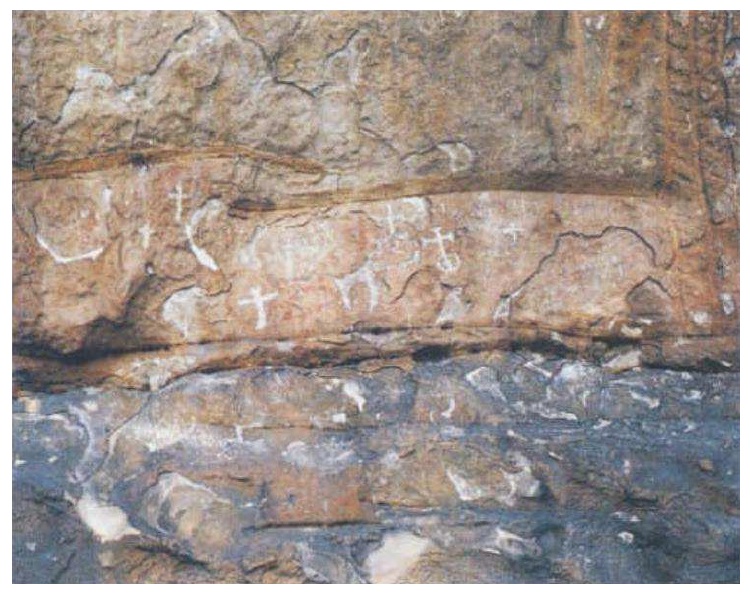
Asturien Peña: Petroglyph mit Kreuzen [kap9 foto9] -- FAKE-Jesus mit Alpha und Omega [kap9 foto12]
Zu Seite 201: Das bekannte Bild von Peña Tu in Asturien mit den vorgeschichtlichen Malereien, die wohl eher zur frühchristlichen Zeit der Westgoten gehören, ins 10. Jahrhundert. (Foto: U. Topper) (S.190)
Zu Seite 201: [Der FAKE]-Christus mit Alpha und Omega. Weiterentwicklung eines heidnischen Motivs. Apokalypse-Illustration von Liebana, Spanien, Ende des 10. Jahrhunderts. (S.191)
Asturias Peña: Petroglyph with crosses [chap9 photo9] -- FAKE-Jesus with Alpha and Omega [chap9 photo12]To page 201: The famous image of Peña Tu in Asturias with prehistoric paintings, which probably belong more to the early Christian period of the Visigoths, in the 10th century. (Photo: U. Topper) (p.190)To page 201: [The FAKE] Christ with Alpha and Omega. Further development of a pagan motif. Apocalypse illustration from Liebana, Spain, late 10th century. (p.191)
-- das "vorgeschichtliche Heiligtum von Peña Tu in Asturien": christliche Fantasie-Kreuze (S.201)
-- "asturische Kirchenbauten der Westgoten", die "wohl ältesten „christlichen“ Gebäude in Westeuropa", mit "Wandfresken weitergeführte rote Malerei, die ins 10. Jahrhundert datiert werden kann" (Foto S.190) (S.201)
-- Felsengräber für die Menschen, aus dem Fels herausgehauen (S.201)
-- Höhlenmalereien sind thematisch fast immer mit dem Totenkult verbunden oder bilden diesen sogar ab (S.201)
Topper Zitat:
"Zu den spanischen Felsmalereien gehören die menschenförmigen Gräber, die aus dem gewachsenen Fels herausgehauen sind. Oft liegen die Höhlen mit den Malereien, die thematisch fast stets zum Totenkult gehören, ganz nahe bei den Körpergräbern oder bringen sogar Abbildungen davon." (S.201)
-- the 'prehistoric sanctuary of Peña Tu in Asturias': Christian fantasy crosses (p.201)
-- 'Asturian church buildings of the Visigoths', which are 'probably the oldest “Christian” buildings in Western Europe', with 'wall frescoes continuing the red painting, which can be dated to the 10th century' (Photo p.190) (p.201)
-- Rock graves for the people, hewn from the rock (p.201)
-- Cave paintings are thematically almost always associated with the cult of the dead or even depict it (p.201)
Topper quote:
"The Spanish rock paintings include anthropomorphic graves that are hewn from the living rock. Often, the caves with the paintings, which are almost always thematically related to the cult of the dead, are very close to the body graves or even depict images of them." (p.201)
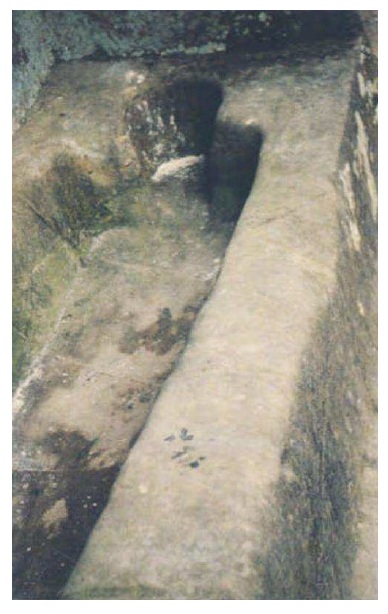
Einweihungsgrab, um eine Wiederauferstehung zu "spielen" [kap9 foto10]
Zu Seite 201: Das Einweihungsgrab bei den Externsteinen: heidnischer Ritus mit christlichem Deckmantel. (Foto: U. Topper) (S.190)
Inauguration grave, to 'play' a resurrection [chap9 photo10]
To page 201: The inauguration grave at the Externsteine: pagan rite with a Christian facade. (Photo: U. Topper) (p.190)
-- Archaeology dates the stone graves mostly to the 9th to 11th centuries - they are witnesses of the early 'Christian era' [with 'Christian symbols'], with baptismal fonts, with monk cells, but still without a cross at the grave (p.201)
-- Rock graves are increasingly being found on the Iberian Peninsula and in North Africa, 'from northern Portugal through Andalusia to Algeria', as well as in Alsace and in the 'Externsteine' (a rock formation in the Teutoburg Forest, Lower Saxony, Germany [web10]) (p.201)
-- die Archäologie datiert die Steingräber meistens ins 9. bis 11.Jh. - es sind Zeugen der ersten "Christenzeit" [mit "christlichen Symbolen"], mit Taufbecken, mit Mönchszellen, aber noch ohne Kreuz am Grab (S.201)
-- Felsengräber werden auf der Iberischen Halbinseln und in Nordafrika immer mehr gefunden, "von Nordportugal über Andalusien bis Algerien", ebenso im Elsass und in den "Externsteinen" (eine Felsformation im Teutoburger Wald, Niedersachsen, Deutschland [web10]) (S.201)
(p.202)
Spanien Provinz Cádiz: Felsgräber [kap9 foto14]
Felsgräber in Körperform in der spanischen Provinz Cádiz (Foto: U. Topper, 1972)
Spain, Province of Cádiz: Rock Tombs [chap9 photo14]
Rock tombs in the shape of bodies in the Spanish province of Cádiz (Photo: U. Topper, 1972)
Nordportugal: typisches Felsgrab [kap9 foto15]
Ein typisches Felsgrab auf einem Dorfplatz in Nordportugal, das der Einweihung diente (Foto: U. Topper).
North Portugal: typical rock grave [chap9 photo15]
A typical rock grave in a village square in North Portugal, which served for the inauguration (Photo: U. Topper).
9.5.G. Das Totenritual bei der Einweihung ins "Christentum": Das Spiel "Tod und Wiederauferstehung" - und der Fantasie-Jesus ist DASSELBE
-- die Frühkirchen spielten bei der Aufnahme in die Gruppe scheinbar "Tod und Wiederauferstehung", genannt "Grablege": Die Anwärterperson musste sich durch dieses Ritual einweihen und aufnehmen lassen (S.201), musste sich in ein Felsengrab legen, mental sterben und dann neu erweckt werden (S.203).
Topper Zitat:
"Ein wichtiges Ritual war dabei die lebendige „Grablege“. Wer sich einweihen oder sich aufnehmen lassen wollte, musste sich in zeremoni- (S.201) eller Weise in das Körpergrab im Fels legen und wurde nach einem vergeistigten Todesdurchgang wieder erweckt." (S.203)
-- dadurch sollte die Person souverän gegenüber dem Tod werden bzw. den Tod sollte es nicht mehr geben (S.203).
9.5.G. The Death Ritual at the Initiation into 'Christianity': The Game 'Death and Resurrection' - and the Fantasy Jesus is THE SAME
-- The early churches seemingly played 'Death and Resurrection' during the admission into the group, called 'Tomb Setting': The candidate had to initiate and be accepted through this ritual (p. 201), had to lie in a rock tomb, mentally die, and then be resurrected (p. 203).
Topper quote:
"An important ritual was the living "Tomb Setting". Whoever wanted to be initiated or accepted had to ceremonially lie in the body grave in the rock and was resurrected after a spiritual death passage." (p. 203)
-- thus the person was supposed to become sovereign towards death, or rather, death was no longer supposed to exist (p. 203).
Topper Zitat:
"Als „Zweimalgeborener“ gehörte er nun zu denen, über die der Tod keine Macht hat." (S.203)
-- dem Fantasie-Jesus wurde dasselbe Ritual mit "Tod und Auferstehung" zugeschrieben (S.203)
Topper Zitat:
"Daraus entstand bruchlos Tod und Auferstehung des Jesus von Nazareth als Stellvertreter für alle Menschen." (S.203)
Topper quote:
"As a 'twice-born' he was now one of those over whom death has no power." (p.203)
-- the Fantasy Jesus was attributed the same ritual of "death and resurrection" (p.203)
Topper quote:
"This seamlessly resulted in the death and resurrection of [Fantasy] Jesus of [Fantasy] Nazareth as a representative for all people." (p.203)
9.5.H. Die Seele geht "in den Himmel" - die "Passionsspiele"
-- die Passionsspiele wurden im "Hochmittelalter" in ganz Europa regelmässig aufgeführt (S.203)
-- hier soll die Seele [in den Himmel] geführt werden (S.203)
-- in der "Loa" in Spanien werden "noch Texte aus dem 16. Jahrhundert wörtlich benutzt" (S.203)
-- in der Carmina Burana (eine Sammlung mit alten Lied- und Dramentexten aus dem Jesus-Fantasie-Kloster Benediktbeuern [web11]) sind "gut erhaltene Rollentexte zu Passionsspielen aus dem frühen 14. Jahrhundert" (S.203)
Topper Zitat:
"Passionsspiele, die im Hochmittelalter in allen Gebieten Europas aufgeführt wurden, halte ich für die direkte Fortsetzung der „Seelenführungen“. Man schaue sich die traditionelle „Loa“ in spanischen Städten an, die teilweise noch Texte aus dem 16. Jahrhundert wörtlich benutzt. Im deutschen Bereich haben wir zum Beispiel in der Liederhandschrift der Carmina Burana mehrere gut erhaltene Rollentexte zu Passionsspielen aus dem frühen 14. Jahrhundert." (S.203)
9.5.H. The soul goes "to heaven" - the "Passion plays"
[Passion plays=Fantasy suffering of a Fantasy Jesus=Fantasy gospel]
-- The Passion plays were regularly performed throughout Europe in the "High Middle Ages" (p. 203)
-- Here, the soul is to be led [to heaven] (p. 203)
-- In the "Loa" in Spain, "texts from the 16th century are still used literally" (p. 203)
-- In the Carmina Burana (a collection of ancient songs and dramatic texts from the Jesus-fantasy monastery of Benediktbeuern [web11]), there are "well-preserved role texts for Passion plays from the early 14th century" (p. 203)
Topper quote:
"I consider Passion plays, which were performed in all areas of Europe during the High Middle Ages, to be the direct continuation of the 'soul leadings.' One should look at the traditional 'Loa' in Spanish cities, which still sometimes uses texts from the 16th century verbatim. In the German-speaking area, we have several well-preserved role texts for Passion plays from the early 14th century, for example in the song manuscript of the Carmina Burana." (p.203)
9.5.I. Analyse: Zitate in der Fantasie-Bibel stammen von Trinksprüchen oder Fantasie-Komödien
-- der Fantasie-Jesus spricht Formulierungen, die "auf heidnische Trinksprüche zurückgehen, die zu rituellen Gelagen gehörten, aber nun anderen Sinn erhielten" (S.203)
-- der Spruch des Fantasie-Jesus "der Geist sei willig und das Fleisch sei schwach" im Fantasie-Garten Gethsemane soll ein Trinkspruch der UReinwohner sein (Fantasie-Matthäus Kap. 26, 39-44) (S.203)
-- ein Detail im Bekehrungserlebnis des Fantasie-Paulus vor Damaskus stammt aus der Fantasie-Komödie "Die Bakchen" des Fantasie-Euripides (Ranke-Heinemann im Buch von Detering: Paulusbriefe ohne Paulus? 1995, S. 30) (S.203)
-- die Fantasie-Offenbarung des Johnannes soll das erste der "christlichen" Bücher gewesen sein [mit Geheimwissen], das aber erst zuletzt - gemäss Topper wahrscheinlich im 11.Jh. - in den Kanon aufgenommen wurde (S.203)
9.5.I. Analysis: Quotes in the fantasy Bible come from drinking sayings or fantasy comedies
-- the fantasy Jesus speaks phrases that "originate from pagan drinking sayings that belonged to ritual feasts but have now acquired a different meaning" (p. 203)
-- the saying of the fantasy Jesus "the spirit is willing but the flesh is weak" in the fantasy garden of Gethsemane is said to be a drinking saying of the natives (Fantasy Matthew Chap. 26, 39-44) (p. 203)
-- a detail in the conversion experience of the fantasy Paul before Damascus comes from the fantasy comedy "The Bacchae" by fantasy Euripides (Ranke-Heinemann in Detering's book: Letters of Paul without Paul? 1995, p. 30) (p. 203)
-- the fantasy revelation of John is said to have been the first of the "Christian" books [with secret knowledge], which was only included in the canon at the very end - according to Topper probably in the 11th century - (p. 203)
Topper Zitat:
"Mehrere Worte Jesu gehen auf heidnische Trinksprüche zurück, die zu rituellen Gelagen gehörten, aber nun anderen Sinn erhielten, wie etwa der (Matthäus 26, 39-44) von Jesus im Garten Gethsemane, der Geist sei willig und das Fleisch schwach.
Bekannt ist auch, daß ein Detail im Bekehrungserlebnis des Paulus vor Damaskus aus dem Bakchen fest des Euripides stammt (Ranke-Heinemann bei Detering 1995, S. 30).
Ich nehme an, daß die Urform der Offenbarung des Johannes ebenfalls szenisch aufgeführt oder mit verteilten Rollen gelesen wurde. Nach Ansicht vieler Theologen war sie das erste christliche Buch und hat sich darum so spät gegen den neu zu schaffenden Kanon durchgesetzt. Man mußte die Apokalypse erst zur Seite schieben, bevor man sie angleichen konnte. Das geschah wohl im 11. Jahrhundert. (Diese Datierung stammt nicht von den Theologen, sondern von mir.)" (S.203)
Topper quote:
"Several words of Jesus trace back to pagan drinking sayings that were part of ritual feasts, but which took on different meanings, such as the one (Matthew 26:39-44) of Jesus in the Garden of Gethsemane, where the spirit is willing but the flesh is weak.
It is also known that a detail in the conversion experience of Paul before Damascus originates from the Bacchae of Euripides (Ranke-Heinemann in Detering 1995, p. 30).
I assume that the original form of the Revelation of John was also staged or read with distributed roles. According to many theologians, it was the first Christian book and thus managed to be included in the newly established canon only late. The apocalypse had to be set aside before it could be harmonized. This probably happened in the 11th century. (This dating does not come from theologians, but from me.)" (p. 203)
9.5.J. Faktor Illustrationen: ab 980 für die Fantasie-Evangelien
-- vor dem 10.Jh. ist KEINE Illustration "zum Bibelbuch" bekannt (S.203)
-- erste Illustrationen sind von Beatus von Lijbana in Nordspanien, die nach 980 geschaffen wurden, wie Vergleiche zeigen (S.203)
Topper Zitat:
"Wann die Offenbarung geschrieben wurde, ist nicht mehr erkennbar, aber soviel ist sicher: Vor dem 10. Jahrhundert gibt es keine Illustrationen zu diesem (oder einem anderen) Bibelbuch. Die Illustrationen des Beatus von Lijbana in Nordspanien sind wahrscheinlich die ersten Illustrationen zu einem Bibeltext; sie können nicht vor 980 geschaffen sein, wie Vergleiche mit den anderen Beaten gezeigt haben. Alle Evangelien sind jünger." (S.203)
9.5.J. Factor Illustrations: from 980 for the Fantasy Gospels
-- before the 10th century, NO illustration "for the Bible book" is known (p. 203)
-- the first illustrations are from Beatus of Liébana in Northern Spain, created after 980, as comparisons show (p. 203)
Topper quote:
"When the Revelation was written is no longer recognizable, but one thing is certain: before the 10th century, there are no illustrations for this (or any other) Bible book. The illustrations of Beatus of Liébana in Northern Spain are probably the first illustrations for a Bible text; they cannot have been created before 980, as comparisons with other Beatuses have shown. All Gospels are younger." (p. 203)
9.5.K. Faktor Übersetzungen
-- die FAKE-Offenbarung wurde 987 ins Georgische übersetzt (S.203)
-- es existiert eine "Handschrift des heiligen Euthymius" (S.203)
-- es ist nicht sicher, dass die Jahreszahl stimmt (S.203)
Topper Zitat:
"Alle Evangeliare sind jünger. 987 wurde die Offenbarung ins Georgische übersetzt, es gibt eine Handschrift des heiligen Euthymius. Wenn diese Jahreszahlen verläßlich sind – was keineswegs selbstverständlich ist –, haben wir einen ersten Datierungsansatz für den Beginn der Bibelniederschrift." (S.203)
9.5.K. Factor Translations
-- the FAKE revelation was translated into Georgian in 987 (p.203)
-- there exists a "manuscript of Saint Euthymius" (p.203)
-- it is not certain that the year is correct (p.203)
Topper quote:
"All Gospels are younger. The revelation was translated into Georgian in 987, there is a manuscript of Saint Euthymius. If these dates are reliable – which is by no means a given – we have a first dating approach for the beginning of the writing of the Bible." (p.203)
9.6. Annäherung [von Spruchsammlungen zum Fantasie-"Kanon"]
9.6.A. Die ersten Spruchsammlungen
9.6.B. Zahlenmystik in den Fantasie-Evangelien - und im Fantasie-Koran - Code 114 (112+2)
9.6.C. Die Verstärkung der frohen Fantasie-Botschaft durch "Verdoppelung"
9.6.D. Korrekturen an den Fantasie-Evangelien: Das Fantasie-Abendmahl - und der Fantasie-Jesus wird zum Anti-Alkoholiker
9.6.E. Koran gegen Alkohol
9.6. Approach [from collections of sayings to the Fantasy "canon"]
9.6.A. The first collections of sayings
9.6.B. Number mysticism in the fantasy gospels - and in the fantasy Quran - Code 114 (112+2)
9.6.C. The reinforcement of the joyful fantasy message through "doubling"
9.6.D. Corrections to the fantasy gospels: The fantasy Last Supper - and the fantasy Jesus becomes the anti-alcoholic
9.6.E. Quran against alcohol
9.6.A. Die ersten Spruchsammlungen
-- die Vorstufe der Fantasie-Evengelien bestand aus Spruchsammlungen, und der Fantasie-Jesus war noch nicht erfunden (S.204)
Topper Zitat:
"Zuerst gab es noch kein Evangelium, das eine fortlaufende Geschichte geboten hätte, sondern nur Sammlungen umlaufender Sprüche, die unter der noch nicht ausgeformten Person Jesu vereinigt wurden." (S.204)
-- das Thomas-Fantasie-Evangelium soll "recht alt" sein, mit 114 Aussagen des Fantasie-Jesus (S.204)
-- der Fantasie-Thomas soll diktiert und sein Fantasie-Zwillingsbruder Judas soll die Fantasie-Jesus-Sprüche aufgeschrieben haben (S.204)
9.6.A. The first collections of sayings
-- the preliminary stage of the fantasy gospels consisted of collections of sayings, and the fantasy Jesus had not yet been invented (p. 204)
Topper quote:
"At first, there was no gospel that offered a continuous story, but only collections of circulating sayings that were brought together under the still undeveloped person of Jesus." (p. 204)
-- the Thomas fantasy gospel is said to be "quite old," with 114 sayings of the fantasy Jesus (p. 204)
-- the fantasy Thomas is said to have dictated, and his fantasy twin brother Judas supposedly wrote down the sayings of the fantasy Jesus (p. 204)
9.6.B. Zahlenmystik in den Fantasie-Evangelien - und im Fantasie-Koran - Code 114 (112+2)
-- dabei ist Zahlenmystik zu berücksichtigen mit dem Code 112+2 (S.204)
Topper Zitat:
"Ein heute nicht mehr anerkanntes, aber offensichtlich recht altes Evangelium ist das des Thomas. Es enthält 114 Aussprüche Christi. Diese Zahl ist kennzeichnend, weil sie sonst keinen Sinn macht. 112 wäre als 28 mal 4 eine sinnvolle Sakralzahl, die zum Kalenderbereich gehört: Wem die kürzeste Abfolge von 5, 6, 11 und 6 Jahren zur Erreichung desselben Wochentages für den Jahresbeginn (oder Ostern) zu kompliziert war, der nahm gebündelt 28 Jahre; da dies ausserdem noch die Summe aller Zahlen von 1 bis zur heiligen Sieben ist, wurde 28 zur heiligsten Zeitrhythmuszahl. Und wer noch einen olympischen Vierjahreszyklus mitbeachten wollte, der musste einen 112jährigen Rhythmus anlegen." (S.204)
-- der Fantasie-Koran hatte ursprünglich 112 Suren, 2 Gebete wurden noch "angehängt", also Code 114 wie bei den Aussagen des Fantasie-Jesus (S.204)
Topper Zitat:
"Der Koran enthielt ursprünglich 112 Suren, denen noch zwei Gebete am Schluss angehängt wurden, um zur Zahl 114 zu gelangen. Hier ist die gegenseitige Abhängigkeit zwischen Evangelium und Koran offensichtlich." (S.204)
9.6.B. Numerical Mysticism in the Fantasy Gospels - and in the Fantasy Quran - Code 114 (112+2)
-- here, numerical mysticism should be taken into account with the code 112+2 (p. 204)
Topper quote:
"A gospel that is no longer recognized today, but which is evidently quite old, is that of Thomas. It contains 114 sayings of Christ. This number is characteristic because it otherwise makes no sense. 112 would be a meaningful sacred number as 28 times 4, which belongs to the calendar area: For those who found the shortest sequence of 5, 6, 11, and 6 years to achieve the same weekday for the start of the year (or Easter) too complicated, they consolidated it to 28 years; since this is also the sum of all numbers from 1 to the sacred seven, 28 became the holiest time rhythm number. And for those who still wanted to consider an Olympic four-year cycle, they had to establish a 112-year rhythm." (p. 204)
-- the fantasy Koran originally had 112 surahs, with 2 prayers added at the end, thus reaching the total of 114, similar to the statements of the fantasy Jesus (p. 204)
Topper quote:
"The Koran originally contained 112 surahs, to which two prayers were added at the end to reach the number 114. Here, the interdependence between the Gospel and the Koran is obviously evident." (p. 204)
9.6.C. Die Verstärkung der frohen Fantasie-Botschaft durch "Verdoppelung"
-- das Matthäus-Fantasie-Evengelium ist fast gleich dem Fantasie-Thomas (S.204)
-- Topper meint, beide Fantasie-Evangelien - von Fantasie-Thomas und Fantasie-Matthäus - seien ev. sogar gleichzeitig, das heisst, innerhalb einer Generation gedichtet worden, das "scheint mir naheliegend" (S.204)
[Scheinbar hat einer vom andern abgeschrieben und etwas variiert - um so die frohe Fantasie-Botschaft "verdoppelt"].
9.6.C. The reinforcement of the joyful fantasy message through "doubling"
-- the Matthew fantasy Gospel is almost identical to the Fantasy Thomas (p. 204)
-- Topper believes that both fantasy gospels - of fantasy Thomas and fantasy Matthew - may have been composed even simultaneously, meaning within one generation, which "seems plausible to me" (p. 204)
[It appears that one copied from the other and varied it a bit - thereby "doubling" the joyful fantasy message - or the forger was even 2 times the SAME person]
9.6.D. Korrekturen an den Fantasie-Evangelien: Das Fantasie-Abendmahl - und der Fantasie-Jesus wird zum Anti-Alkoholiker
-- Korrekturen zwischen den Fantasie-Evangelien sind teilweise noch "zeigbar" (S.204)
-- beim Fantasie-Lukas lehnt der Fantasie-Jesus beim Fantasie-Abendmahl den Wein ab und schenkt nur seinen Fantasie-Jüngern ein, mit "Kelchsegen" (S.204)
-- beim Fantasie-Markus meint der Fantasie-Jesus nach dem Essen, er werde nun Anti-Alkoholiker und trinke nie mehr Wein (S.204)
-- beim Fantasie-Matthäus schliesslich kommt alles in der "richtigen Reihenfolge und mit theologischer Begründung ("Sündenvergebung")" (S.204)
-- dabei ist das "Abendmahl" ein Brauch der UReinwohner, der "Heiden" (!) (S.204)
-- beim Fantasie-Johannes ist das Abendmahl mit Gottesurteil WEGGELASSEN, weil es nicht in des Schreibers Konzept passte (S.204)
9.6.D. Corrections to the fantasy Gospels: The Fantasy Last Supper - and the Fantasy Jesus becomes an anti-alcoholic
-- Corrections between the fantasy Gospels are partially still "visible" (p. 204)
-- in the Fantasy Luke, the Fantasy Jesus refuses wine during the Fantasy Last Supper and only serves his Fantasy Disciples, with a "chalice blessing" (p. 204)
-- in the Fantasy Mark, the Fantasy Jesus states after the meal that he will now become an anti-alcoholic and will never drink wine again (p. 204)
-- in the Fantasy Matthew, everything happens in the "correct order and with theological justification ('forgiveness of sins')" (p. 204)
-- here, the "Last [Fantasy] Supper" is a custom of the indigenous people, the "heathens" (!) (p. 204)
-- in the Fantasy John, the Last Supper is OMITTED due to God's judgment because it did not fit the writer's concept (p. 204)
Topper Zitat:
"Man nehme sich die Abendmahlsgeschichte vor, die zuerst bei Lukas vorkommt, wo Jesus noch enthaltsam den Wein ablehnt und nur seinen Jüngern ausschenkt; besser gestaltet in Markus, wo er nach dem Essen sagt, dass er von nun an keinen Wein mehr trinken wird; zurück zu Lukas, wo der Kelchsegen nun doch nach dem Essen angefügt wird; und dann endlich in richtiger Reihenfolge und mit theologischer Begründung („Sündenvergebung“) bei Matthäus. Damit ist keine Reihenfolge der Entstehung dieser Texte angegeben, sondern ihre Gleichzeitigkeit und gegenseitige Abhängigkeit. (Der romanhafte Johannes hat dieses heidnische Mahl mit Gottesurteil weggelassen, es passte nicht in sein mystisches Konzept.)" (S.204)
9.6.E. Koran gegen Alkohol
"Übrigens gibt es auch im Koran— wenngleich nur ganz knapp — eine dreistufige Ablehnung des Weingenusses." (S.205)
Topper Quote:
"One should examine the Last Supper story, which first appears in Luke, where Jesus abstains from wine and only serves it to his disciples; better represented in Mark, where after the meal he states that he will no longer drink wine; back to Luke, where the blessing of the cup is now included after the meal; and finally in correct order and with theological justification ('forgiveness of sins') in Matthew. This does not indicate a chronological order of the emergence of these texts, but rather their simultaneity and mutual dependence. (The novelistic John omitted this pagan meal with divine judgment, as it did not fit into his mystical concept.)" (p. 204)
9.6.E. Koran against alcohol
"By the way, there is also a three-tiered rejection of wine consumption in the Koran—albeit only very briefly." (p. 205)
9.7. [Fantasie-Kalender]: Jahreszählungen
9.7.A. Die Jesus-Fantasie-Kirche mit Fantasie-Jahreszahlen
9.7.B. Der "christliche" Kalender verglichen mit dem muslimischen Kalender
9.7.C. Die Fantasie-Wirkungszeit eines Fantasie-Jesus: 1 bis 5 Jahre
9.7.D. Kalender-Chaos: Schon das Judentum prophezeite im FANTASIE-Talmud ein "Ende der Welt" im Jahre 4250 jüdischer Zeitrechnung (=1250 "christliche" Zeitrechnung)
9.7.E. Kalender-Chaos: Fantasie-Kalender mit Olympiade
9.7. [Fantasy calendar]: different year countings
9.7.A. The Jesus Fantasy Church with Fantasy Year Numbers
9.7.B. The 'Christian' Calendar Compared to the Muslim Calendar
9.7.C. The Fantasy Duration of a Fantasy Jesus: 1 to 5 Years
9.7.D. Calendar Chaos: Even Judaism Prophesied in the FANTASY Talmud an 'End of the World' in the Year 4250 Jewish Calendar (= 1250 'Christian' Calendar)
9.7.E. Calendar Chaos: Fantasy Calendar with Olympics
9.7.A. Die Jesus-Fantasie-Kirche mit Fantasie-Jahreszahlen
-- August Strobel (deutscher Jesus-Fantasie-Theologe 1930-2006 [web12]) hat in seinem Werk "Ursprung und Geschichte des frühchristlichen Osterkalenders" (1977) zig Daten gesammelt, um das Todesdatum des Fantasie-Jesus herauszufinden und meinte am Ende: Der 7. April 30 sei "praktisch sicher" (S.205)
Topper Zitat:
"Mit bewundernswertem Fleiss und grosser Kenntnis hat August Strobel (1977) noch einmal alle erreichbaren Hinweise auf das genaue Todesdatum Jesu zusammengestellt und dadurch herausgefunden, dass es praktisch sicher am 7. April des Jahres 30 erfolgt sein muss." (S.205)
-- die Zeitverschwendung für eine christliche Jesus-Fantasie ist umwerfend (S.205)
Topper Zitat:
"Der Aufwand an Gelehrsamkeit und Zeit, der insgesamt investiert wurde, lässt einen Kritiker erblassen." (S.205)
9.7.A. The Jesus Fantasy Church with Fantasy Years
-- August Strobel (German Jesus Fantasy Theologian 1930-2006 [web12]) collected numerous dates in his work "Origin and History of the Early Christian Easter Calendar" (1977) to determine the death date of the fantasy Jesus and concluded at the end: April 7 in the year 30 is "practically certain" (p. 205)
Topper quote:
"With admirable diligence and great knowledge, August Strobel (1977) compiled once again all available clues about the exact date of Jesus's death and thereby determined that it must have practically certainly occurred on April 7 of the year 30." (p. 205)
-- the waste of time for a Christian Jesus fantasy is staggering (p. 205)
Topper quote:
"The amount of scholarship and time that has been invested overall makes a critic pale." (p. 205)
-- die strengen Kirchenforscher meinen, es fehle ein Kalender der alten Kulturen mit durchgezählten Jahren [dabei gibt es weltweit 100e Kalender, aber die kennen die "Kirchenforscher" nicht] (S.205)
Topper Zitat:
"Alle neueren Forscher nahmen nämlich, ohne zu fragen, an, dass die Jahre von Cäsar (oder eher) bis zu uns ohne Unterbrechung durchgezählt worden seien, so dass astronomische und kalendarische Berechnungen ein schlüssiges Datum für Jesus ergeben müssten. Doch durchgezählte Jahre sind nirgendwo belegbar. Man kann höchstens von einer angenommenen antiken Jahreszählung, etwa den Olympiaden, auf eine spätere, etwa die Märtyrer-Ara, übergehen und von dieser dann auf unsere heutige Anno-Domini-Zählung." (S.205)
-- the strict church researchers believe that there is a lack of a calendar of the ancient cultures with counted years [even though there are hundreds of calendars worldwide, but the 'church researchers' are not aware of them] (p. 205)
Topper quote:
"All modern researchers assumed, without questioning, that the years from Caesar (or rather) to us were counted continuously, so that astronomical and calendrical calculations must yield a conclusive date for Jesus. However, counted years are not verifiable anywhere. One can at best transition from a presumed ancient year count, such as the Olympiads, to a later one, such as the era of the martyrs, and from this to our current [FANTASY] Anno Domini counting." (p. 205)
[Ergänzung: Die Kalender der alten Kulturen wurden vom kr. Vatikan und seinen kriminellen Heeren und Armeen teilweise vernichtet
Viele Quellen zu Kalendern von vor dem "Christentum" wurden vom kriminellen Gay-Drogen-Vatikan durch den Jesus-Wahn-Kolonialismus vernichtet:
-- die Kalender der Kelten-Kulturen in Europa,
-- die Quellen der Maya-Kulturen in Mexiko,
-- Tartaria im heutigen Russland wurde "untergegangen",
-- Atlantis wurde "untergegangen" etc. etc. etc.
Aber viele andere Kalender existieren weiter wie in Indien, Thailand, China, Japan usw.].
[Addendum: The calendars of ancient cultures were compiled by kr. Vatican and its criminal armies and armies
Many sources on calendars from before "Christianity" were destroyed by the criminal gay drug Vatican through Jesus delusion colonialism:
-- the calendars of the Celtic cultures in Europe,
-- the sources of the Mayan cultures in Mexico,
-- Tartaria in today's Russia was "destroyed",
-- Atlantis was "destroyed" etc. etc. etc.
But many other calendars continue to exist, such as in India, Thailand, China, Japan, etc.].
9.7.B. Der "christliche" Kalender verglichen mit dem muslimischen Kalender
-- an den Übergängen von einem neuen Kalender zum anderen sind Fehler möglich wie bei der Koordination zwischen dem "christlichen" und dem muslimischen Kalender - wenn man genau kontrolliert, wurden beide Kalender um das Jahr 1000 installiert (S.205)
Topper Zitat:
"An beiden Übergängen sind aber Fehler im Grössenbereich von vielen Jahrhunderten möglich. Die älteste durchgehende Jahreszählung dürfte die islamische sein („Hedschra“ oder „Hegira“ genannt, abgekürzt H.), die heute das Jahr 1418 verzeichnet und vielleicht ab 100 H., spätestens aber ab 300 H. belegbar ist. Da die islamischen Jahre 11 Tage kürzer als die christlichen sind, kommen wir mit dieser Zählung maximal 1375 Jahre zurück. Erst ab dem Jahr 1000 n.Chr. haben wir eine relativ vertrauenswürdige Gleichsetzung der beiden Zählweisen. Wie man leicht ersehen kann, hat diese Behauptung den Nachteil, dass alle rückberechneten astronomischen Aussagen (Finsternisse, Kometen, Sternaufgänge oder Präzession) für den Zeitraum vor 1000 wertlos sind." (S.205)
9.7.B. The "Christian" calendar compared to the Muslim calendar
-- at the transitions from one new calendar to another, errors are possible, as is the case with the coordination between the Fantasy "Christian" and the Fantasy Muslim calendar - when checked carefully, both Fantasy calendars were established around the year 1000 (p. 205)
Topper quote:
"At both transitions, however, errors in the order of many centuries are possible. The oldest continuous year counting is likely to be the Islamic one (called [Fantasy] 'Hedschra' or 'Hegira', abbreviated H.), which today marks the year 1418 and may be verifiable from 100 H., but at the latest from 300 H. Since the Islamic years are 11 days shorter than the [Fantasy] Christian ones, with this counting we can go back a maximum of 1375 years. Only from the year 1000 AD do we have a relatively reliable equivalence of the two [Fantasy] counting methods. As can be easily seen, this claim has the disadvantage that all retro-calculated astronomical statements (eclipses, comets, star rises or precession) are worthless for the period before 1000." (p.205)
9.7.C. Die Fantasie-Wirkungszeit eines Fantasie-Jesus: 1 bis 5 Jahre
August Strobel mit seiner treuherzigen Analyse [gemäss der alten FAKE-Chronologie] macht im Buch "Ursprung und Geschichte des frühchristlichen Osterkalenders" (1977) die Textfälschungen in den Fantasie-Evangelien sichtbar (S.205-206)
Buch von Strobel auf Seite 103:
-- das Lukas-Fantasie-Evengelium behauptet, der Fantasie-Jesus sei im Jahr 15 des Fantasie-Kaisers Tiberius getauft worden (28/29) (S.206)
-- im selben oder spätestens im Jahr 16 (29/30) sei der Fantasie-Jesus gekreuzigt worden (S.206)
-- es sei also höchstens ein einziges Jahr seines Wirkens möglich gewesen, dies bestätigen auch die ältesten Texte der Jesus-Fantasie-Gnostiker (S.206)
-- die "Scholastiker" und "Humanisten", die die byzantinischen "Kirchenväter" gedichtet haben, nehmen für den Fantasie-Jesus 2 bis 3 Jahre "Wirkungszeit" an (S.206)
9.7.C. The imaginary duration of influence of an imaginary Jesus: 1 to 5 years
Mr. August Strobel, with his earnest analysis [according to the old FAKE chronology], makes the textual forgeries in the imaginary gospels visible in his book "Origin and History of the Early Christian Easter Calendar" (1977) (pp. 205-206)
Strobel's book on page 103:
-- The Luke imaginary gospel claims that the imaginary Jesus was baptized in the year 15 of the imaginary Emperor Tiberius (28/29) (p. 206)
-- In the same year or, at the latest, in year 16 (29/30), the imaginary Jesus was crucified (p. 206)
-- Therefore, at most a single year of his influence was possible, which is also confirmed by the oldest texts of the Jesus-fantasy Gnostics (p. 206)
-- The "Scholastics" and "Humanists," who fabricated the Byzantine "Church Fathers," assume a duration of influence of 2 to 3 years for the imaginary Jesus (p. 206).
-- zur Zeit, als ein Fantasie-Tatian ERFUNDEN wurde, der die vier verschiedenen Fantasie-Evangelien vereinheitlicht haben soll, die Fantasie-"Evangelienharmonie" "war die Diskussion voll im Gange" (S.206) - der FANTASIE-Tatian, offiziell aus Ost-Syrien, gestorben im Jahr 170 [web13]
-- die Fantasie-Wirkungszeit des Fantasie-Jesus war zuerst auf ein Jahr beschränkt (Fassung in NL, Toskana, Persien), auf 1,5 bis 2 Jahre ausgedehnt (altenglisch), aber auch auf 2 bis 3 Jahre ausgedehnt (altdeutsche und arabische Fassungen), eine weitere Ausdehnung der Wirkungszeit auf 4 oder 5 Jahre wurde angedacht, "aber wieder abgeblasen" (S.206)
-- bei Augustin wurde die lange Wirkzeit nachträglich hineinkorrigiert (S.206)
-- einige Theologen führten mehrere Standpunkte auf, z.B. Prosper von Aquitanien "5. Jahrhundert" (S.206)
-- die Ausweitung der Fantasie-Wirkung des Fantasie-Jesus kam durch eschatologische Gedanken (Erlösungs-Hoffnung [web14]), meint auch Strobel (ab S. 100, bes. 109) (S.206)
-- at the time when a fantasy Tatian was INVENTED, who was supposed to have unified the four different fantasy gospels, the fantasy 'Gospel Harmony' 'the discussion was fully underway' (p.206) - the FANTASY Tatian, officially from East Syria, died in the year 170 [web13]
-- the fantasy duration of the fantasy Jesus was initially limited to one year (version in NL, Tuscany, Persia), extended to 1.5 to 2 years (Old English), but also extended to 2 to 3 years (Old German and Arabic versions), a further extension of the time of influence to 4 or 5 years was considered, 'but was canceled again' (p.206)
-- With Augustine, the long duration was retroactively corrected [by another forger] (p.206)
-- Some theologians cited several viewpoints, e.g. Prosper of Aquitaine '5th century' (p.206)
-- The expansion of the fantasy influence of the fantasy Jesus came through eschatological thoughts (redemption hope [web14]), Strobel also means (from p. 100, especially p. 109) (p.206)
Topper Zitat:
"([Buch von Strobel] S. 103): Aus dem Lukas-Evangelium geht hervor, daß Jesus im 15. Jahr des Kaisers Tiberius getauft wurde (28/29) und im selben oder spätestens im 16. Jahr (29/30) gekreuzigt wurde. Er konnte also höchstens ein Jahr wirken. »Dieser Standpunkt ist von einem vordergründigen Verstehen der Evangelien her eingenommen. Schon für die Gnostiker war er anziehend«, will sagen: die ältesten Texte bezeugen dies. Die byzantinischen „Kirchenväter“, die ja durchweg von den Scholastikern und Humanisten der lateinischen Kirche erst geschrieben wurden, nehmen lieber eine 2- bis 3jährige Wirkzeit Jesu an. In der Zeit, als die Evangelienharmonie des „Tatian“ verfaßt wurde, war die Diskussion voll im Gange. Man bringt zunächst ein Jahr (in der niederländischen, toskanischen und persischen Fassung), weitet dann auf anderthalb bis zwei Jahre aus (altenglisch) und erhält schließlich 2 bis 3 Jahre (altdeutsch und arabisch). Eine weitere Ausdehnung auf vier oder gar fünf Jahre wurde aber wieder abgeblasen. Nicht einmal alle großen Kirchenväter haben die lange Wirkzeit, bei Augustin mußte sie erst in seine frühen Schriften eingebaut werden; die späteren Schriften hatten wohl zwecks Archaisierung ein Jahr gebracht. Bei einigen Theologen wurden beide Standpunkte nebeneinander aufgeführt (Prosper von Aquitanien, „5. Jahrhundert“). Daß hauptsächlich eschatologische Gedanken zur Ausweitung führten, hat Strobel klar erkannt ([Buch von Strobel] ab S. 100, bes. 109)." (S.206)
Topper quote:
"(Book by Strobel, p. 103): It is evident from the [Fantasy] Gospel of [Fantasy] Luke that [a Fantasy] Jesus was [Fantasy] aptized in the 15th year of [Fantasy] Emperor Tiberius (28/29) and was [Fantasy] crucified in the same year or at the latest in the 16th year (29/30). Thus, he could have only had a maximum of one [Fantasy] year of ministry. 'This viewpoint is taken from a superficial understanding of the [Fantasy] Gospels. It was already appealing to the Gnostics,' meaning: the oldest texts testify to this. The Byzantine [Fantasy] 'Church Fathers,' who were indeed written by the scholastics and humanists of the Latin [Fantasy] Church, prefer to assume a ministry of [Fantasy] Jesus lasting 2 to 3 years. At the time when the [Fantasy] Gospel harmony of '[Fantasy] Tatian' was created, the discussion was fully underway. Initially, one year is proposed (in the Dutch, Tuscan, and Persian versions), then it expands to one and a half to two [Fantasy] years (Old English), and finally reaches 2 to 3 [Fantasy] years (Old High German and Arabic). A further extension to four or even five years was again called off. Not even all the great [Fantasy] Church Fathers had the long term; with [Fantasy] Augustine, it had to be incorporated into his early writings first; the later writings probably introduced a [Fantasy] year for the sake of archaism. In some theologians, both viewpoints were presented side by side (Prosper of Aquitaine, '5th century'). That mainly eschatological thoughts led to the extension has been clearly recognized by Strobel (Book by Strobel, p. 100, especially p. 109)." (p.206)
-- Änderungen wurden z.B. um 1250 vorgenommen: Tiberius soll gerettet werden und es wurden nun Kaiserdaten angepasst (S.206)
Topper Zitat:
"Das zeigt den frühesten Zeitpunkt für den Änderungsvorgang an, um 1250. Damit nun Tiberius gerettet wird, muss auf das probate Mittel der Mitregentschaft“ oder „Provinzialherrschaft“ (seit 15 Jahren auf dem Kaiserthron, aber schon seit 19 Jahren Herrscher in der Provinz) zurückgegriffen werden." (S.206)
-- zur Datumsbestimmung des Fantasie-Todes eines Fantasie-Jesus wurden auch die Daten von Fantasie-Gnostikern herangezogen (S.206)
Topper Zitat:
"Natürlich wurden auch die ketzerischen Gnostiker durch [FAKE]-Klemens von Alexandria zur Datumsbestimmung des Todes Jesu herangezogen, obgleich sie weder Interesse an dergleichen Überlegungen haben konnten noch überhaupt anderweitig nachweisbar sind. Aber dieser Hinweis auf (geringfügig) abweichende Daten wird eben als „Beweis“ für die Ernsthaftigkeit dieses Diskussionsgegenstandes angeführt." (S.206)
-- Changes were made around 1250, for example: Fantasy Tiberius is to be saved, and imperial Fantasy data has now been adjusted (p. 206)
Topper quote:
"This indicates the earliest point for the alteration process, around 1250. In order for [Fantasy] Tiberius to be saved, it is necessary to resort to the useful means of [Fantasy] co-regency or [Fantasy] 'provincial rule' (since 15 years on the imperial throne, but already a ruler in the province for 19 years)." (p. 206)
-- For the determination of the Fantasy date of the fictional death of a fictional Jesus, the dates of Fantasy Gnostics were also consulted (p. 206)
Topper Quote:
"Of course, the heretical [Fantasy] Gnostics were also consulted by [FAKE] Clement of Alexandria for the determination of the date of Jesus's death, even though they could have had no interest in such considerations nor are they verifiably present elsewhere. But this reference to (slightly) differing dates is being presented as 'evidence' for the seriousness of this discussion topic." (p. 206)
-- die Diskussion um das Fantasie-Sterbedatum eines Fantasie-Jesus soll den Fantasie-Jesus real erscheinen lassen (!) (S.206)
Topper Zitat:
"Die Geschichtlichkeit Jesu wird erst dann real, wenn die Gegner sie ebenfalls diskutieren." (S.206)
-- Strobel bezieht in seine Untersuchung auch jüdische Kalendersysteme ein, auch Maimonides (1135-1204), (S.206-207), aber dann wird wieder klar, dass das Epizentrum der Geschehnisse knapp vor 1000 gewesen sein kann, weil ihre Schriften erst ab dann "wirksam" werden (S.207)
Topper Zitat:
"Strobel bemüht auch die jüdischen Kalendersysteme bis hin zu Mai- (S.206) monides (1135-1204), aber gerade an diesem Phänomen wird am besten deutlich, dass die Tempelzerstörung und Zerstreuung der Moses-Anhänger noch nicht lange vor 1000 stattgefunden haben kann. Ihre Schriften werden in Europa erst ab diesem Zeitpunkt wirksam." (S.207)
-- the discussion about the imaginary date of death of an imaginary Jesus is intended to make the imaginary Jesus seem real (!) (p.206)
Topper quote:
"The historicity of Jesus only becomes real when the opponents discuss it as well." (p.206)
-- Strobel also incorporates Jewish Fantasy calendar systems into his investigation, including Maimonides (1135-1204), (p.206-207), but then it becomes clear again that the epicenter of events can only have occurred shortly before 1000 because their Fantasy writings only become 'effective' from that point on (p.207)
Topper quote:
"Strobel also makes use of the Jewish [Fantasy] calendar systems up to Maimonides (1135-1204), but this phenomenon illustrates best that the destruction of the temple and the dispersion of [Fantasy] Moses followers could not have occurred long before 1000. Their [Fantasy] writings only became effective in Europe from that time onward." (p.207)
-- Strobel bezieht in seine Untersuchung auch jüdische [Fantasie]- Kalendersysteme ein, auch Maimonides (1135-1204), (S.206-207), aber dann wird wieder klar, dass das Epizentrum der Geschehnisse knapp vor 1000 gewesen sein kann, weil ihre Schriften erst ab dann "wirksam" werden (S.207)
Topper Zitat:
"Strobel bemüht auch die jüdischen [Fantasie]-Kalendersysteme bis hin zu Mai- (S.206) monides (1135-1204), aber gerade an diesem Phänomen wird am besten deutlich, dass die Tempelzerstörung und Zerstreuung der [Fantasie]-Moses-Anhänger noch nicht lange vor 1000 stattgefunden haben kann. Ihre [Fantasie]-Schriften werden in Europa erst ab diesem Zeitpunkt wirksam." (S.207)
-- Strobel presents the Armenian [Fantasy] version of the fictitious Eusebius with the fictitious Olympiad calculation as a temporal center of the calendar, and then a Fantasy astronomer 'Phlegon' is also invented, along with a great Fantasy solar eclipse, accompanied by a Fantasy earthquakes, etc., which aligns with the Fantasy death of the Fantasy Jesus in the Luke Fantasy Gospel (23:44-45) (p. 207).
Topper quote:
"Furthermore, Mr. Strobel also mentions the Armenian version of the [FAKE] Eusebius, which provides the Olympiad calculation: Jesus’ [Fantasy] death is in the 4th year of the 203rd [Fantasy] Olympiad (correct would be 01. 202.4). However, determining the timing according to this system makes no sense at all. It is done through an even more conspicuous detour: a certain Mr. [Fantasy] Phlegon, 'famous ancient astronomer' of the 2nd century AD, who is certainly invented, mentions at this time a great solar [Fantasy] eclipse with [a Fantasy] earthquakes, etc., which precisely fits the events claimed in the [Fantasy] Gospel of [Fantasy] Luke (23:44-45) at the time of Jesus' [Fantasy] death." (p. 207)
-- with this solar eclipse, the fantasy death of the fantasy Jesus is now theologically 'secured', even if the solar eclipse did not occur around April, but rather around August (p. 207)
Topper quote:
"About the solar eclipse that is retro-calculated to the desired year 30, although not during [Fantasy] Easter time, but half a year later [this is: in August or in September]. Thus, the [Fantasy] death of a [Fantasy] Jesus is now finally chronologically [Fantasy] 'secured'." (p. 207)
-- Overall, the Jesus Fantasy theologians can thus CHOOSE how long the Fantasy Jesus is supposed to have acted, with the retro-calculated lunar eclipse for Passover of the year 33 available for this purpose (p. 207)
Topper quote:
"A lunar eclipse also retro-calculated in the Renaissance for Passover of the year 33 is used by those theologians who prefer a longer period of Jesus' [Fantasy] activity. A layperson stands there shaking their head." (p. 207)
-- Fakt ist: Der Fantasie-Jesus wurde 1000 Jahre zurückverschoben hingesetzt, heute (Stand 2000) sollen es 2000 Jahre "Abstand" sein (S.207)
-- traditionelle Jesus-Fantasie-Theologen werden weiterhin alle neuen Erkenntnisse ablehnen und über das Fantasie-Todesdatum des Fantasie-Jesus diskutieren: 7.April 30 oder 3.April 33 (S.207)
[und die kriminellen Theologen haben die Eigenschaft, alle Wahrheitswisser als "Anti-Christen" zu rufmorden, um ALLE NEUEN ERKENNTNISSE ABZULEHNEN, solange dieses kriminelle Wort in der FAKE-Bibel steht. Das ist dieselbe Abwehr-Taktik, die die Zionisten mit dem Wort "Nazi" anwenden].
Topper Zitat:
"Haben Strobel und die vielen Vorgänger diesen offensichtlichen Zirkelschluß nicht bemerkt?
Vermutlich wird es einigen Theologen, die ja hundertfach besseren Einblick in die ganze Materie haben, jetzt wie Schuppen von den Augen fallen. Viele Verrenkungen, die nötig waren, um die Echtheit des fast 2000jährigen Abstands von Jesus bis heute aufrecht zu erhalten, werden nun durchsichtig. Einige werden die Nase rümpfen über soviel Unkenntnis und sich wieder ihrem Lieblingsthema zuwenden, der Bestimmung, ob der 7. April 30 oder der 3. April 33 das Todesdatum ihres Jesus war." (S.207)
-- The fact is: The fantasy Jesus was pushed back 1000 years, today (as of 2000) there should be a 2000 year "gap" (p. 207)
-- traditional Jesus-fantasy theologians will continue to reject all new insights and discuss the fantasy death date of the fantasy Jesus: April 7, 30 or April 3, 33 (p. 207)
[and the criminal theologians have the characteristic of calling all truth-knowers "anti-Christians" in order to reject ALL NEW INSIGHTS, as long as this criminal word is in the FAKE Bible. This is the same defensive tactic that the Zionists use with the word "Nazi"].
Topper quote:
"Did Strobel and the many predecessors not notice this obvious circular reasoning?
Probably some theologians, who have a hundred times better insight into the whole matter, will now see it as if scales have fallen from their eyes. Many contortions that were necessary to maintain the authenticity of the almost 2000 year gap from Jesus to today..."
Presumably, some theologians, who indeed have a hundredfold better insight into the entire matter, will now see things clearly as if scales have fallen from their eyes. Many contortions that were necessary to maintain the authenticity of the almost 2000-year gap from Jesus to today will now become transparent. Some will wrinkle their noses at such ignorance and return to their favorite topic, the determination of whether April 7, 30, or April 3, 33, was the date of their Jesus' death.
[The only calendar that is true is the lunar calendar with 13x28+1 days].
9.7.D. Kalender-Chaos: Schon das Judentum prophezeite im FANTASIE-Talmud ein "Ende der Welt" im Jahre 4250 jüdischer Zeitrechnung (=1250 "christliche" Zeitrechnung)
Topper Zitat:
"Etwa so: In den „um 300 bis 400“ geschriebenen Talmud-Texten der orientalischen Juden wird das Weltende auf 4200 oder 4250 Jahre nach Erschaffung der Welt gelegt, »weil« (so Strobel, S. 448) 84 Jahre (das ist ein Sonne-Mondzyklus) mal 50 Jubeljahre 4200 ergibt. Da die Weltschöpfung in Auswertung des Alten Testamentes durch christliche Autoren auf 3000 vor Christus gelegt wurde, damit dieser in der Mitte der alttestamentlichen 6000 Weltjahre liegt, kommt die Welt also um 1200 oder 1250 n.Chr. zu ihrem verdienten Ende." (S.207)
9.7.D. Calendar Chaos: FANTASY Judaism also prophesied in the FANTASY Talmud a FANTASY 'end of the world' in the year 4250 in the Jewish FANTASY calendar (=1250 'Christian' calendar)
Topper quote:
"About this: In the Talmud texts written by the Eastern [Fantasy] Jews around 300 to 400, the end of the world is set for 4200 or 4250 years after the creation of the world, 'because' (according to Strobel, p. 448) 84 years (which is one sun-moon cycle) times 50 jubilee years equals 4200. Since the creation of the world, based on the Old [Fantasy] Testament, was placed by Christian [Fantasy] authors at 3000 B [Fantasy] C so that it falls in the middle of the Old [Fantasy] Testament's 6000 years of world history, the world is thus destined to end around 1200 or 1250 AD." (p.207)
-- The whole 'Occident' believed in the [Fantasy] "downfall" and in the "Last [Fantasy] Judgment" during this period around 1200 or 1250 (p. 207)
Topper quote: 'We know this date, it is the first real period during which people in the Occident believed that the Last [Fantasy] Judgment was near.' (p. 208)
-- According to Topper, the [Fantasy] Talmud is likely to have been written shortly before 1000 (p. 208)
Topper quote:
'The Talmudic [Fantasy] writings could hardly have been written any earlier. While this doesn't provide proof for my argument, it merely offers a hint, it demonstrates how nonsensical all these speculations about dating [a Fantasy] Jesus are when taken at face value.'
9.7.E. Kalender-Chaos: Fantasie-Kalender mit Olympiade
-- geniessen Sie das Kalender-Chaos mit "olympischen Datierungen" (S.208-209)
-- die Analysen sind im Buch von Kurt Heidrich: Die olympischen Doppeldatierungen, eine Studie zur griechisch-archaischen Geschichte; Ehrenkirchen-Offnadingen 1981
Topper Zitat:
"Die zahlreichen Abweichungen der Olympiaden-Ära, Weltschöpfungs-Ära usw., selbst innerhalb eines Textes, verraten, dass diese Zeitzählung im Augenblick der Abfassung des Textes nicht in Gebrauch war, sonst müsste diese Ära einen einheitlichen Beginn haben. Die unterschiedliche „Epoche“ (Ara-Beginn) zeigt immer an, dass die einzelnen Angaben aus verschiedenen anderen Texten übernommen und vom Autor nicht umgerechnet wurden – oder dass sie frei erfunden sind, was viel näher liegt und häufig zutrifft.
9.7.E. Calendar Chaos: Fantasy Calendars with Olympics
-- Hello! Enjoy the calendar chaos with "Olympic dates" (p. 208-209)
-- The analyses are in the book by Kurt Heidrich: The Olympic Double Dates, a Study of Greek-Archaic History; Ehrenkirchen-Offnadingen (Germany) 1981
(orig. German: Die olympischen Doppeldatierungen, eine Studie zur griechisch-archaischen Geschichte)
Topper quote:
"The numerous discrepancies of the Olympic era, world creation era, etc., even within a single text, reveal that this dating system was not in use at the time the text was composed; otherwise, this era would have a consistent beginning. The different 'epoch' (Ara beginning) always indicates that the individual pieces of information were taken from various other texts and not recalculated by the author – or that they are completely fabricated, which is much more likely and often the case."
To give an example, I am evaluating the very neat study by Heidrich on The Olympic Double Dates (1981). Before 500 BC, there is no reliably dated event of this kind, and afterward, there are only a few. This is primarily due to our knowledge of this dating method: Practically all information is found in [the Fantasy men] Julius Africanus, Clement of Alexandria, and Eusebius; we find almost none in other authors. [Fantasy] Clement begins his Olympic era, which he attributes to an Aristodemus of Elis and Polybius, in the 28th Olympiad (written as 28 01), which makes the first Olympiad 884 BC. [Fantasy] Julius Africanus begins with the 14th Olympiad and names Callimachus as the author, which brings us to the year 828 B [Fantasy] C for its beginning; officially, today's scholars place the start in 776 B [Fantasy] C. In this beautiful confusion, gaps had to be filled once again with individuals who never lived. They had to let Olympians win, extend royal lists, etc.
[Fantasy] Euseb had to correct [Fantasy] Herodotus and even the old [Fantasy] Cicero, who gave a date 140 years later for [Fantasy] Pythagoras. There are also clever adjustments, in which the ecclesiastical dates of the Hebrew [Fantasy] kings, who reign from 997 B. [Fantasy] C., gradually approach each other, which those kings only set from 926 onwards, i.e. show a difference of 71 years, until they meet punctually (p.208) for the Babylonian [Fantasy] captivity, a kind of irrefutable fixed point, with a gap of only about 5 years (with Euseb even only 2 years). A successful game in the Olympic time roulette." (p.209)
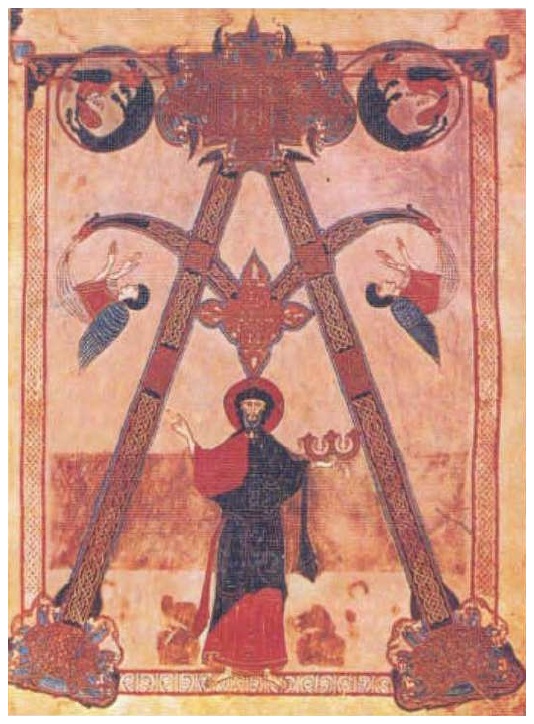
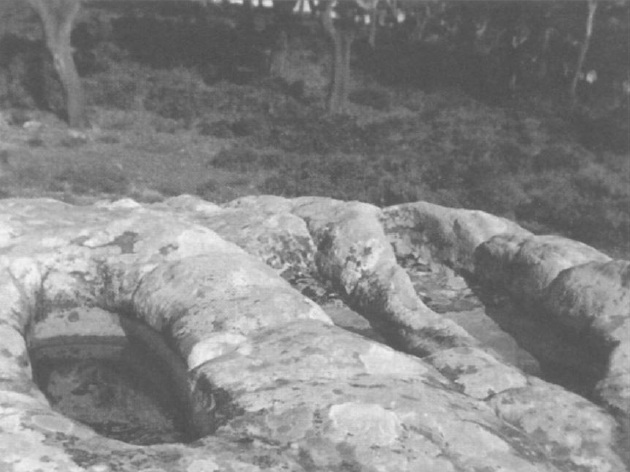
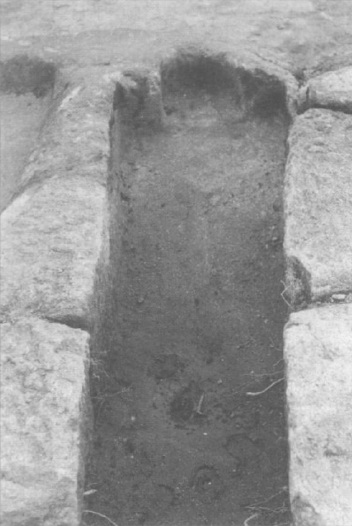
|
|
|
Sources
[web01] https://de.wikipedia.org/wiki/Benjamin_Kennicott
[web02] https://de.wikipedia.org/wiki/Johann_Gottfried_Eichhorn - https://de.wikipedia.org/wiki/Eichhorn_(Familienname)
[web03] https://de.wikipedia.org/wiki/Friedrich_Delitzsch
[web04] https://en.wikipedia.org/wiki/Charles_I_of_England
[web05] https://de.wikipedia.org/wiki/David_Friedrich_Strau%C3%9F
[web06] https://de.wikipedia.org/wiki/Arthur_Drews_(Philosoph)
[web07] https://archive.org/details/verschlusssachej0000baig
[web08] https://de.wikipedia.org/wiki/Limbus_(Theologie)
[web09] https://www.amazon.de/Beyond-Bounds-History-H-Breuil/dp/B0007ISZYI/
[web10] https://de.wikipedia.org/wiki/Externsteine
[web11] https://de.wikipedia.org/wiki/Carmina_Burana
[web12] https://de.wikipedia.org/wiki/August_Strobel
[web13] https://de.wikipedia.org/wiki/Tatian
[web14] https://de.wikipedia.org/wiki/Eschatologie